
Monitoring Artisanal and
Small-Scale Mining at Scale
Building an evidence base for better decisions with Earth observation.
Artisanal and small-scale mining supports the livelihoods of more than 40 million people and remains one of the least consistently monitored forms of mining. This paper examines the regulatory context, the decisions stakeholders actually face, and what effective monitoring requires.
-
How formal, informal and illegal ASM are distinguished
-
The five capabilities effective monitoring depends on
-
How radar and optical data are combined
-
42 pages, fully referenced, World Bank, UNEP, EITI, OECD, Swissaid
What the paper covers
The paper covers ASM from definition through to monitoring requirements. No remote sensing background is assumed.
What ASM is and why it matters globally
How to define ASM and its regulatory context
Decision-making needs across stakeholders
What effective monitoring requires
How Nightshade makes ASM visible at scale
Advancing ASM monitoring with science-grade data
Key figures from the paper
40–45M
World Bank
80+
countries report artisanal and small-scale mining activity.
World Bank
$31B
of gold left Africa undeclared in 2022, an estimated 435 tonnes.
Swissaid
37%
of global mercury emissions come from artisanal gold mining.
UNEP

Worked examples
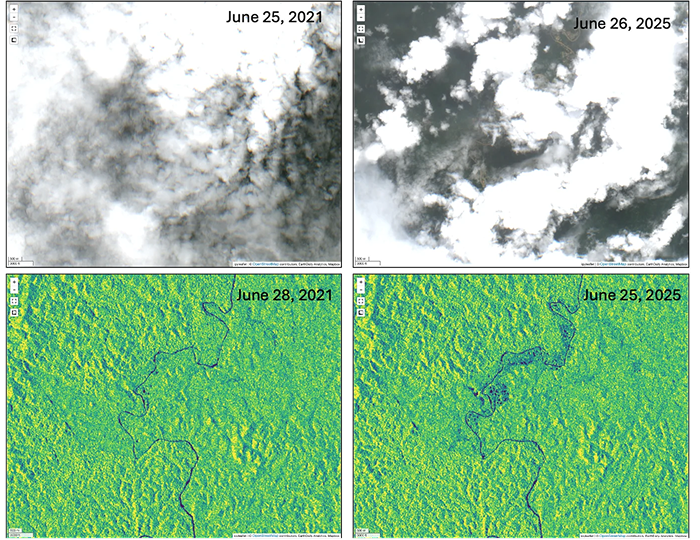
“Effective ASM management depends on understanding where mining activity is occurring, how it is changing over time, and how those changes relate to the surrounding context.”
Understanding where activity is concentrated, how it is evolving, and what it means for the decisions stakeholders face requires repeated observation across space and time — along with the context to interpret it.
Chapters 1, 3 and 5 carry worked examples:
The Sukari district in Egypt, formalization interventions mapped by the World Bank.
Four-year progression along a West African river corridor where cloud hid the activity from optical sensors entirely.
.png?width=480&height=632&name=IMG%20%E2%96%B8%20ASM%20whitepaper%20cover%20(rendered%20from%20p.1).png "IMG ▸ ASM whitepaper cover (rendered from p.1)")
Free download
Download the whitepaper
42 pages, fully referenced and free to download. Covers the regulatory context, the decisions each stakeholder faces, and what effective monitoring requires.