

.jpg?width=289&height=168&name=Data%20Use%20cases%20(1).jpg)
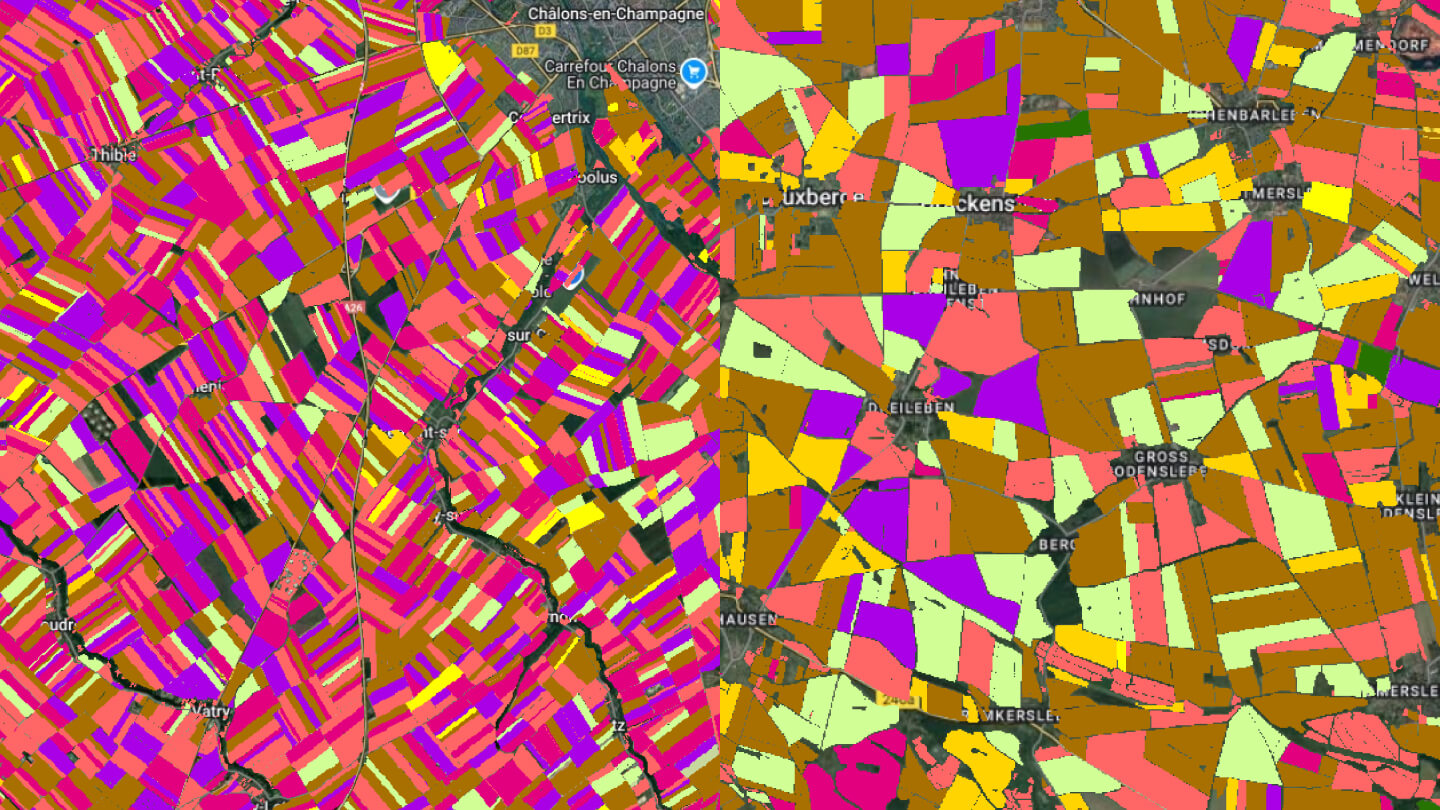
Crop Identification Western Europe:
Unlock In-Season Visibility Across Europe's Agricultural Heartland
France, Germany and the UK together form the agricultural engine of Europe producing wheat that feeds the continent, rapeseed that powers biodiesel markets, and corn that anchors livestock supply chains. Yet decision-makers consistently operate on outdated intelligence, waiting months for official statistics while market conditions evolve.
.png "Crop-ID-France-Expanded-Crop (1)")
The Stakes of European Crop Intelligence
Crop Identification for Western Europe delivers AI-powered crop classification during the growing season, identifying winter wheat, barley, rapeseed, corn, sunflower, and sugarbeet plantings across both countries. From the Beauce plains to Bavaria, from Champagne to Brandenburg, and East Anglia. Know what's planted while it still matters.
With mid-June classification deliveries, Crop Identification enables commodity traders, food companies, and agricultural cooperatives to assess winter crop conditions and evaluate spring crop plantings while strategic decisions can still be influenced. Track acreage distribution, identify regional variations, and refine supply outlooks, months before official statistics arrive.
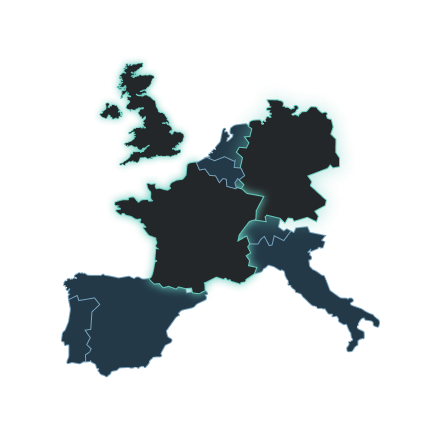
Three Country Coverage: Complete national coverage across France, Germany and the UK
Wheat Markets:
France exports approximately 15–20 million tonnes of soft wheat annually, making it the EU's largest exporter and a critical supplier to North Africa. German wheat feeds domestic milling and livestock sectors. Winter wheat conditions in these two countries substantially influence European grain pricing.
Rapeseed (OSR):
The EU's biodiesel mandate drives consistent demand for rapeseed. France and Germany together account for a significant share of EU production. Planting shifts in either country ripple through vegetable oil markets and renewable fuel supply chains.
CAP Declaration Lag:
While EU farmers submit Common Agricultural Policy declarations, this data often isn't publicly available until well after the growing season. The gap between planting reality and official statistics creates uncertainty for all market participants.
Diverse Cropping Systems:
European agriculture features complex rotations, smaller field sizes, and diverse crop mixes. Accurate classification requires models trained on this complexity—not generic approaches adapted from other regions.
Capabilities
The Crop ID Advantage:
European-Optimized Classification
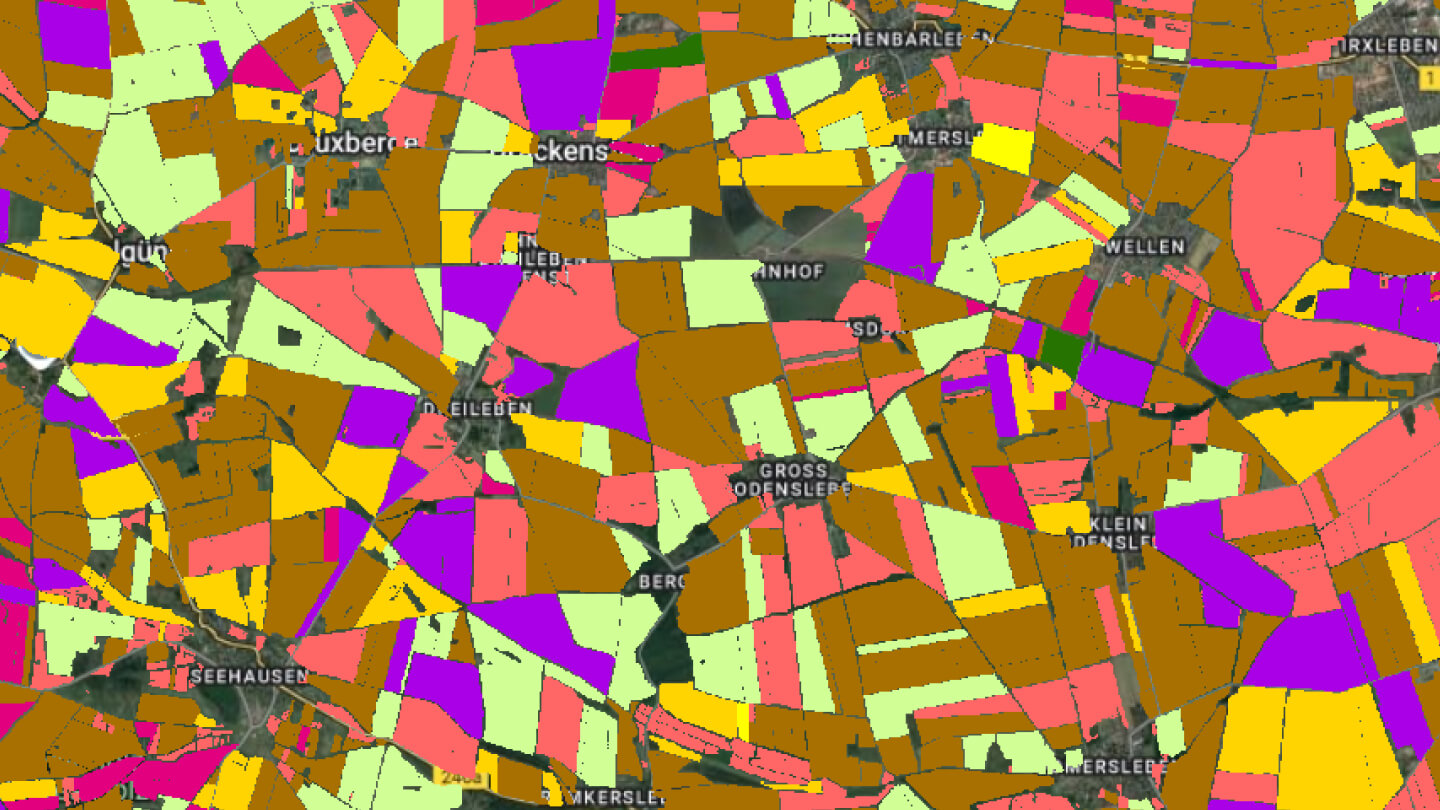
Advanced machine learning models achieve robust accuracy for key crops under operational conditions:
France Performance:
- Rapeseed (OSR): F1 scores > 0.95
- Winter Wheat: F1 scores of 0.85–0.90
- Barley: F1 scores of 0.85–0.90
- Corn: F1 scores of 0.80–0.85
- Sugarbeet: F1 scores of 0.70–0.75
- Sunflower: F1 scores of 0.45–0.50*
Note: Spring crop detection accuracy is limited by mid-June delivery timing, as canopy development may be incomplete.
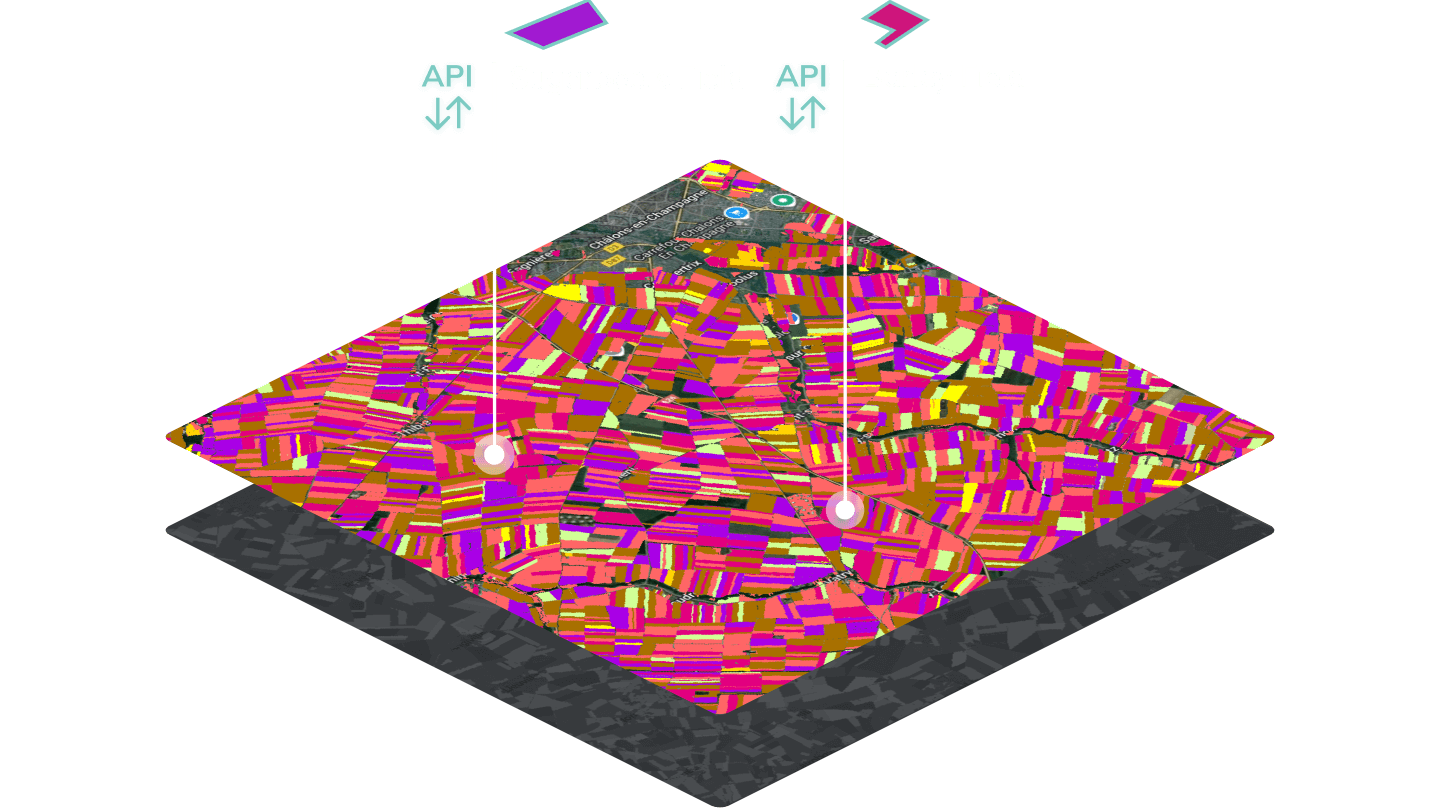
Crop Identification delivers complete classification across the entire territories of France and Germany, not extrapolated estimates from sample regions. Every agricultural zone is mapped, enabling analysis at national, regional, departmental, or individual field levels.
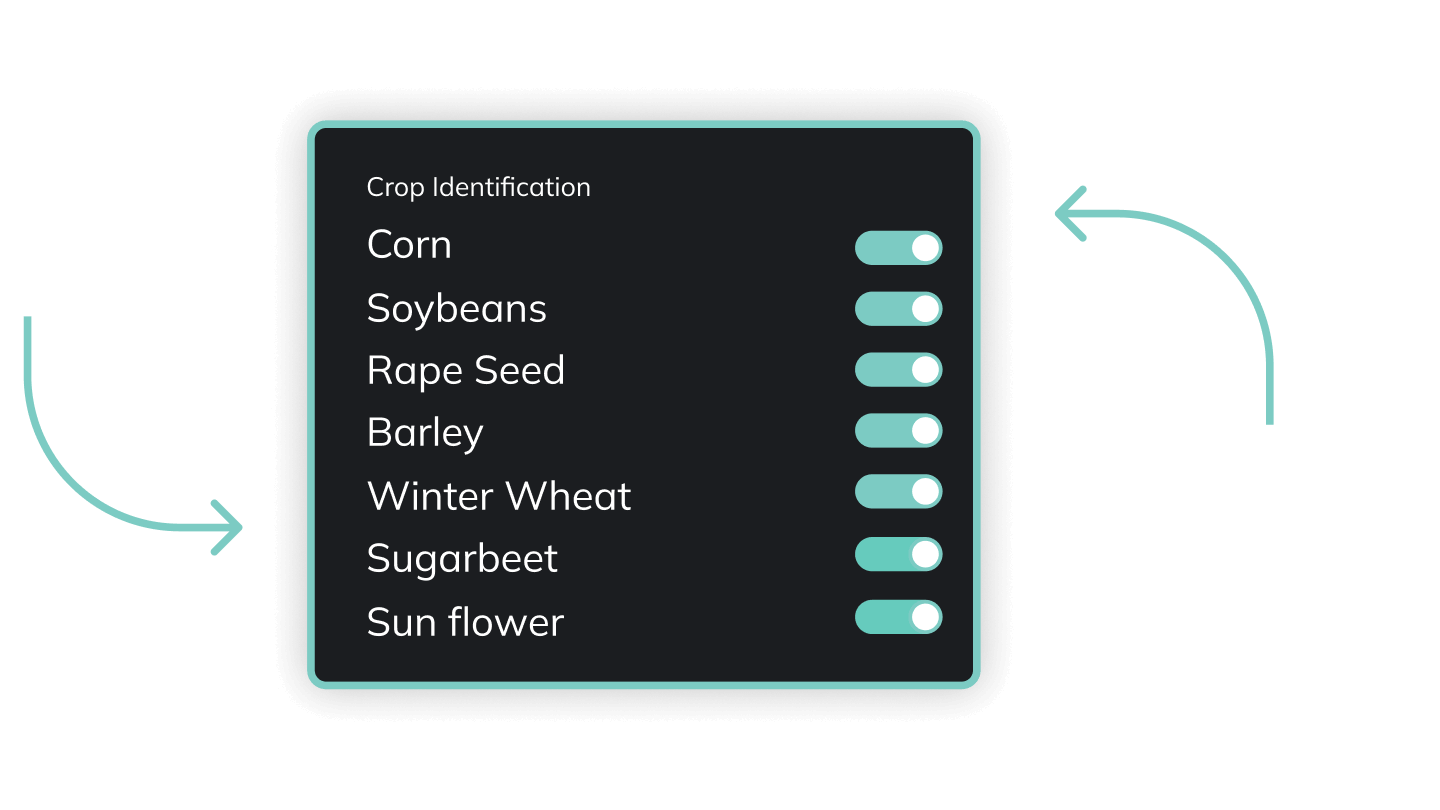
Beyond in-season classification, Crop Identification provides integrated access to historical crop layers from 2019 onward, incorporating public EU datasets including French RPG (Registre Parcellaire Graphique), German CTM (Crop Type Map) and CROME (Crop Map of England) over the UK. One platform, complete historical context.
Real-World Impact
Use Case:
Grain traders, oilseed analysts, commodity hedge funds, export companies
Challenge:
A commodity trading firm active in European oilseed markets relies on historical acreage patterns and delayed CAP data to build rapeseed positions for MATIF contracts. By the time official French production estimates arrive, harvest is underway and pricing has already adjusted. The desk watches competitors consistently capture better entry points, traders with faster intelligence are moving markets while the firm waits for FranceAgriMer reports that confirm what satellites revealed weeks earlier. Spring weather volatility creates additional uncertainty: when cold snaps or drought headlines hit, the desk can't distinguish real acreage impacts from market noise.
Solution:
The trading desk integrates Crop Identification's mid-June classification into their European supply models. Satellite-derived rapeseed identification across France, where the crop's bright yellow flowering stage enables exceptional detection accuracy exceeding 0.95 F1, reveals actual planted acreage while strategic positioning windows remain open. The team assesses winter wheat conditions across both countries, tracks regional variations between the Paris Basin and Bavaria, and validates market assumptions against wall-to-wall satellite evidence rather than extrapolated samples.
Outcome:
When spring weather concerns drive competitors to reduce rapeseed exposure, Crop Identification's mid-June classification shows French acreage consistent with expectations, the crop weathered the cold snap better than headlines suggested. The desk maintains positions while others retreat. As harvest confirms the strong crop, the maintained position outperforms reactive strategies by capturing the spread between panic-driven lows and harvest-confirmed pricing. The early acreage confirmation enabled conviction through market noise, transforming weather volatility from a risk factor into a competitive opportunity.
Use Case:
Optimize Collection and Marketing
Challenge:
A major French coopérative serves 3,000 farmer members across six départements in the Centre-Val de Loire region. Each spring, the logistics team plans harvest collection routes, allocates silo capacity, and negotiates forward sales contracts, all based on member declarations submitted months earlier. But declarations don't capture the reality of what farmers actually planted: some switched from wheat to barley based on late-season price signals; others expanded rapeseed at corn's expense; weather-damaged fields were replanted with different crops entirely. When harvest arrives, the coopérative discovers mismatches between planned capacity and actual deliveries, wheat silos overflow while barley facilities sit half-empty. Forward contracts become difficult to fulfill when actual production diverges from declared volumes.
Solution:
The coopérative integrates Crop Identification's mid-June classification across their entire collection territory. Satellite-derived crop maps reveal what's actually growing in each commune, independent of member declarations. The logistics team overlays classification data on collection routes to optimize truck dispatching by crop type. Storage managers reallocate silo capacity based on satellite-verified acreage rather than outdated declarations. The marketing team adjusts forward contract volumes while there's still time to negotiate amendments.
The coopérative integrates Crop Identification's mid-June classification across their entire collection territory. Satellite-derived crop maps reveal what's actually growing in each commune, independent of member declarations. The logistics team overlays classification data on collection routes to optimize truck dispatching by crop type. Storage managers reallocate silo capacity based on satellite-verified acreage rather than outdated declarations. The marketing team adjusts forward contract volumes while there's still time to negotiate amendments.
Outcome:
Harvest logistics run smoothly for the first time in years, trucks arrive at the right silos because dispatch planning reflected actual crop distribution. Storage utilization improves dramatically as capacity allocation matches real production patterns. Forward contract fulfillment rates increase because volume commitments aligned with satellite-verified acreage rather than optimistic declarations. Member satisfaction rises as the coopérative delivers faster unloading times and competitive pricing enabled by optimized operations. The coopérative transforms from reactive scrambling during harvest to proactive orchestration with satellite intelligence replacing guesswork.
Harvest logistics run smoothly for the first time in years, trucks arrive at the right silos because dispatch planning reflected actual crop distribution. Storage utilization improves dramatically as capacity allocation matches real production patterns. Forward contract fulfillment rates increase because volume commitments aligned with satellite-verified acreage rather than optimistic declarations. Member satisfaction rises as the coopérative delivers faster unloading times and competitive pricing enabled by optimized operations. The coopérative transforms from reactive scrambling during harvest to proactive orchestration with satellite intelligence replacing guesswork.
Next Steps:
Experience In-Season European Crop Intelligence
Transform your European market intelligence with crop classification that arrives during the growing season. Discover how Crop Identification delivers competitive advantage across France, Germany and the UK:
- Schedule a demo to see Crop Identification integrated with your trading or supply chain workflows
- Review crop coverage for your specific commodity interests
- Discuss expansion requirements for additional European countries
FAQs
What crops does Crop Identification classify in Western Europe?
Crop Identification classifies the major crops grown in France, Germany and the UK. In France: Winter Wheat, Barley, Rapeseed (OSR), Corn, Sunflower, and Sugarbeet. In Germany: Winter Wheat, Barley, Rapeseed (OSR), Corn, and Sugarbeet. In the UK: Winter Wheat, Barley, and Rapeseed (OSR). Additional crops can be supported upon request.
How accurate is Crop Identification for European crop classification?
Accuracy varies by crop and country. Rapeseed achieves the strongest performance with F1 scores exceeding 0.95 in France, 0.90–0.95 in Germany and 0.83-0.93 in the UK. Winter wheat and barley perform well at 0.75–0.90 depending on country. Spring crops like corn show more variation, and sunflower detection is limited by early delivery timing.
When are classification layers delivered?
Crop Identification delivers classification in March, July and September, providing assessments of winter crop conditions, spring crops development and end of season evaluation. This timing enables strategic decisions while the growing season remains active and the ability to keep up with both winter and spring cropping seasons. Additional delivery dates can be added upon request.
Why is sunflower accuracy lower than other crops?
Sunflower is a spring-planted crop with later canopy development. At mid-June delivery timing, sunflower canopy may be incomplete in some regions, limiting classification accuracy. As delivery schedules expand, later-season updates will improve spring crop detection.
What regions are covered?
Crop Identification covers the entire national territories of France, Germany and the UK. This includes all major agricultural regions from the Paris Basin to Bavaria, Brittany to Brandenburg and East Anglia. Data can be accessed at national, regional, departmental, or field level.
Is historical data available?
Yes. Crop Identification provides access to historical crop classification layers from 2019 onward, integrating both EarthDaily proprietary classifications and public European datasets (French RPG, German CTM, and UK CROME). This archive supports crop rotation analysis and year-over-year comparisons.
How does Crop Identification relate to CAP declaration data?
Crop Identification complements CAP data by providing in-season classification while official statistics lag. The Field-Level API can validate declared crops against satellite classification, and historical layers include integrated access to RPG, CTM, and CROME reference data.
How is Crop Identification delivered?
Two API-based delivery methods: Crop Mask API (STAC) provides spatially indexed GeoTIFF layers for regional analysis; Field-Level API returns crop predictions for specific field geometries. Both integrate seamlessly into enterprise data pipelines.
Ready to gain visibility across Europe's agricultural heartland?
Contact EarthDaily to access in-season crop classification that transforms how you monitor, trade, and source across French, German and UK agriculture.