

.jpg?width=289&height=168&name=Data%20Use%20cases%20(1).jpg)
An open, distributed ecosystem
for natural disaster risk assessment.
Satellite Earth Observation, drone observations and ground-based sensor
networks, combined into a common environment for storage, discovery,
visualisation and analytics.
Five components developed and
integrated by the consortium.
Intelligent storage framework
A storage layer designed to handle large volumes of high-quality Earth Observation data while reducing operational storage costs compared to traditional cloud bucket storage.
High-performance discovery engine
Discovers, processes and indexes large volumes of new Earth Observation data each day, supporting rapid retrieval across the platform's catalogue.
Visualisation platform
Web-accessible visualisation supporting operational and analytical workflows across all pilot deployments.
Advanced quality query
module
Query and filtering capability that surfaces data fit for purpose by quality, geometry, time window and sensor characteristics.
On-the-fly analytics
Analytics that run against data in place, reducing the need for large-scale data transfer before analysis can begin.
Advanced Calibration and Processing
Transforms raw EarthDaily Constellation satellite data into AI-Ready products for analytics. Ensures high-quality, consistent, and scalable data for NADIR applications.
DATA SOURCES
NADIR ingests data from multiple sources, brought together in an advanced calibration and processing environment.
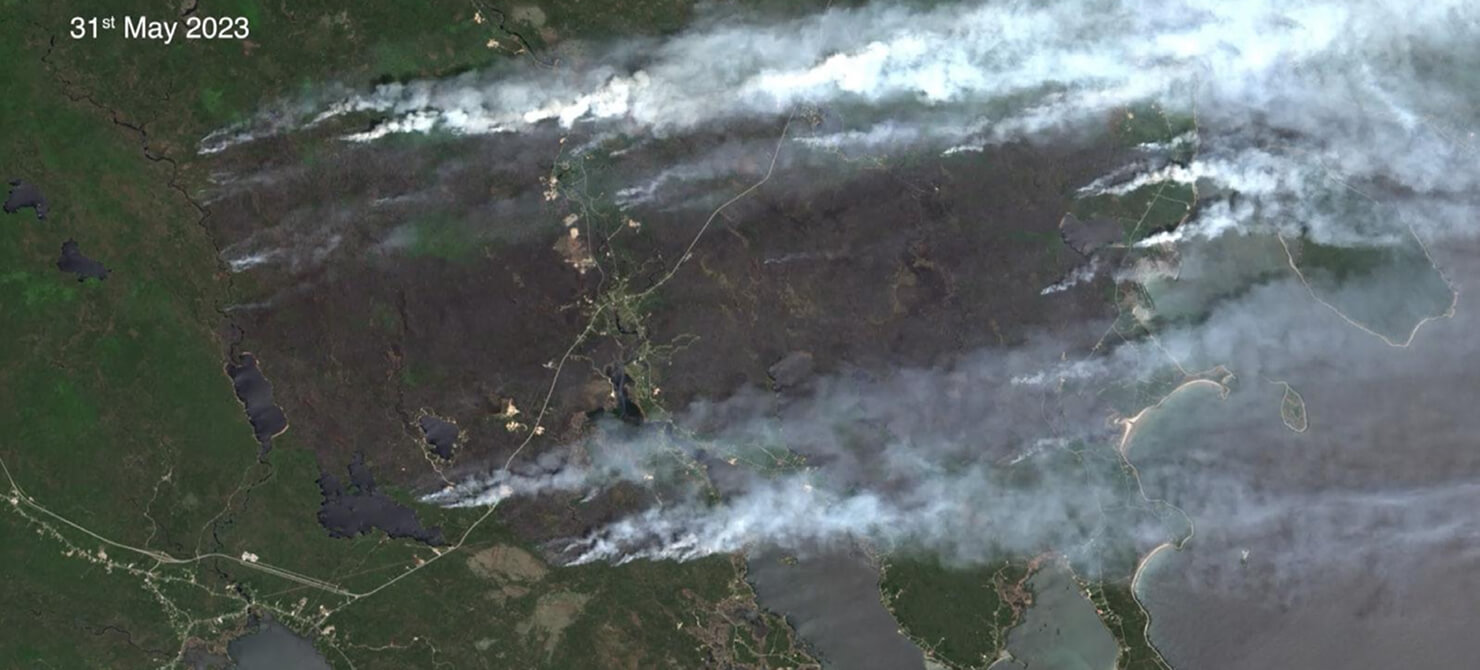
The primary Earth Observation data source. Provides Satellite imagery with consistent acquisition geometry, supporting reliable temporal comparisons for automated change detection.
Ground-truth data collected by Dragon Praxis using Remotely Piloted Aircraft Systems, supporting wildfire applications.
Sensor data from Beia Consult International’s acoustic sensing infrastructure, supporting landslide early warning applications.
Integrated where they support specific pilot use cases — broadening multi-source applicability without locking the platform to any single provider.
AI & MACHINE LEARNING
Information products developed within the platform by consortium partners, integrated through common analytics interfaces
Products share a common platform foundation,
allowing methods developed for one hazard to inform approaches to others
Wildfire detection & risk
assessment
Research and development led by ISEP, focused on machine learning methods that combine satellite, UAV and ground- based observations.
Landslide precursor detection
AI-driven analysis of acoustic sensor data developed by Beia Consult International, integrated with time-critical cloud telemetry.
Algae bloom detection
High-resolution detection methods developed by Naraspace optimised for winter monitoring at river outlets and scalable to global coverage.
NADIR draws on EarthDaily’s existing data infrastructure and developer tooling.
Public API documentation
Programmatic access to EarthDaily Constellation data, supporting integration into custom analytical pipelines and downstream applications.
EarthDaily Python client library
The open-source Python client provides programmatic access to EarthDaily data and supports integration into custom analytical pipelines.
Link to NADIR project Site
NADIR aims to build a natural Hazard/Disaster Risk and Assessment Platform to provide advanced risk assessment products and critical intelligence information to support the mitigation and management of natural hazards/disasters using (new) satellite imaging.
ITEA Official Site
ITEA projects integrate advanced technologies from various fields and focus on deploying those in combination with innovations in the software and systems domain to develop novel integrated solutions, products and services.
Additional NADIR platform interfaces will be published as project deliverables are released. For the most current technical deliverables, refer to the NADIR project page on the ITEA portal.

ITEA is the Eureka RD&I Cluster on software innovation, enabling industry, SMEs, start-ups, academia and customer organisations to collaborate in funded projects.
ITEA turns innovative ideas into new businesses, jobs, economic growth and benefits for society. It is part of the Eureka Clusters Programme (ECP). NADIR is co-funded by National contributions from NRC Canada and ANI Portugal.