
RiverSat
Predict River Levels with Unmatched Precision

RiverSat delivers AI-powered 28-day river level forecasts that transform logistics planning for Europe's critical waterways. Move from reactive crisis management to strategic advantage—with the intelligence to act weeks before low-water events impact operations.

Satellite Imagery of the Rhine river

The Complete River Intelligence Platform

Purpose-built for industrial logistics, RiverSat provides chemical producers, steel manufacturers, power generators, and barge operators with the forecasting precision needed to secure supplies, lock in transport, and maintain operations during low-water events. No hydrology expertise required.

  • AI-Driven River Level Forecasting
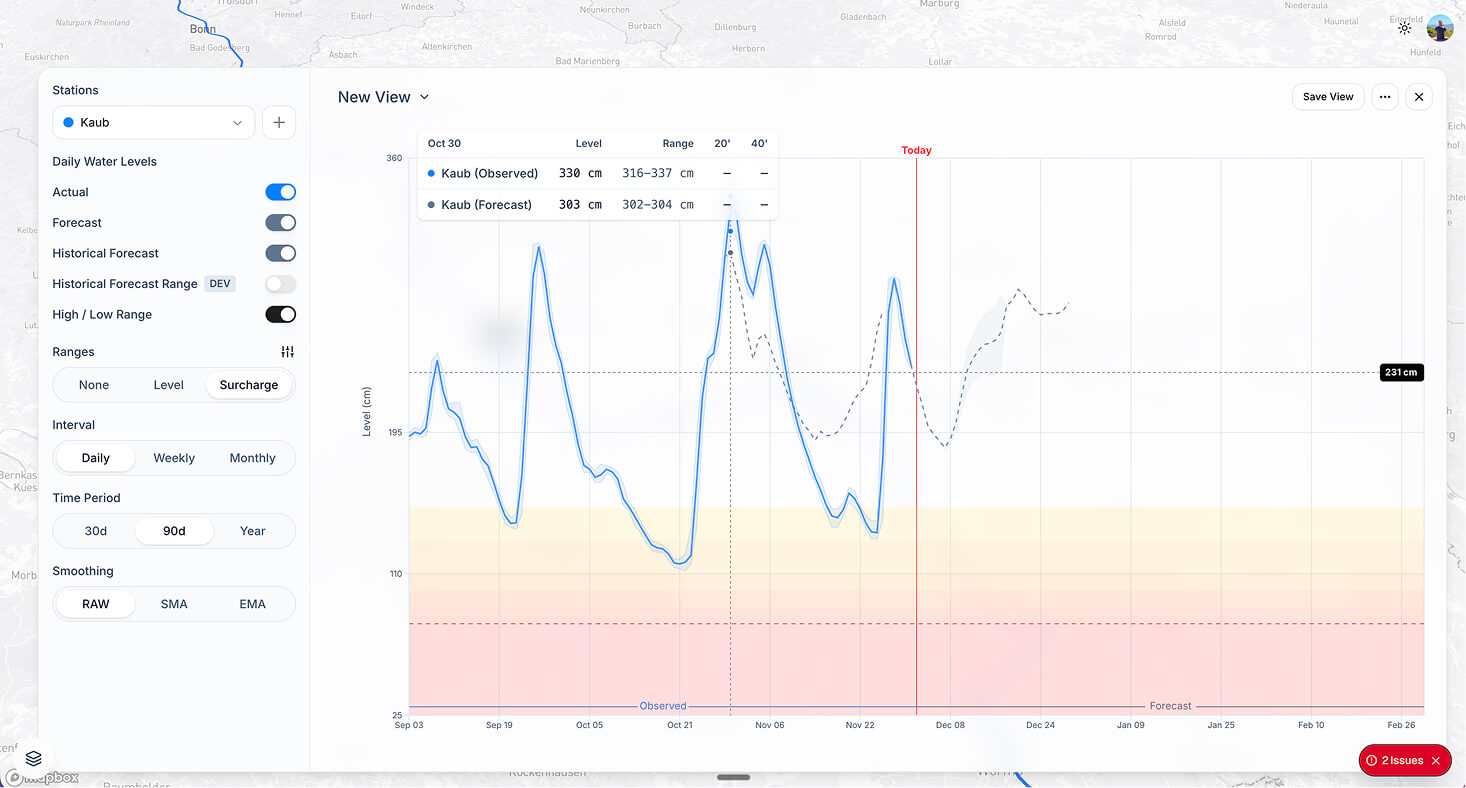
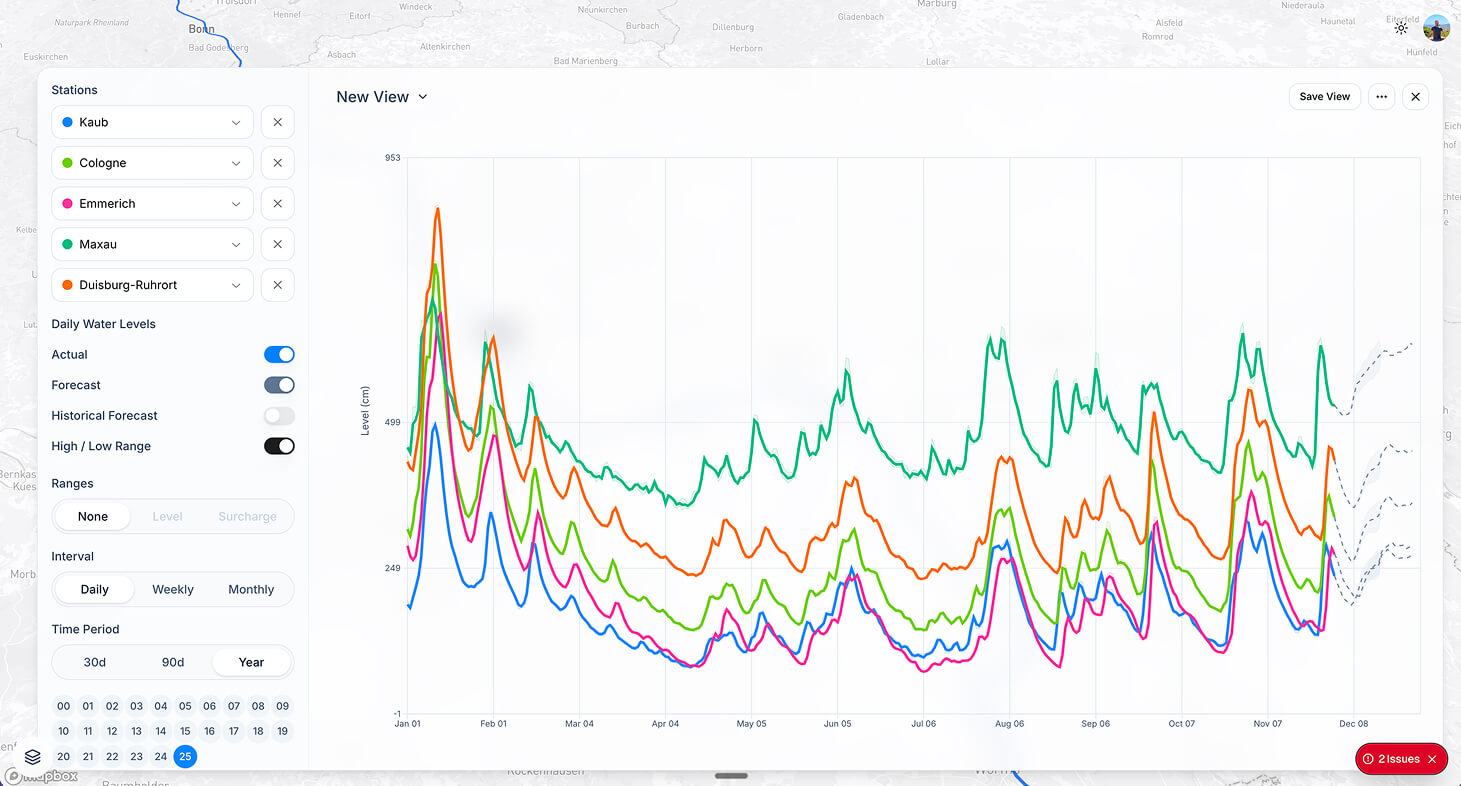
    RiverSat's advanced machine learning models forecast actual river levels at each gauge station—not streamflow proxies—delivering operational certainty for barge transport planning with ±1 day accuracy for minimum water level prediction.


  • Industry-Leading 28-Day Visibility
    Built on multiple weather data sources and cutting-edge AI, RiverSat provides reliable 28-day forecasts while competitors struggle with 10-day limits. This extended visibility transforms strategic planning from reactive to proactive.


  • Built by a Proven Team of Experts
    Developed by EarthDaily Analytics' forecasting team, RiverSat applies the same rigorous AI/ML methodology that powers agricultural intelligence for global commodity markets—now optimized for industrial logistics and low-water event prediction.

Why Choose RiverSat for Logistics Planning

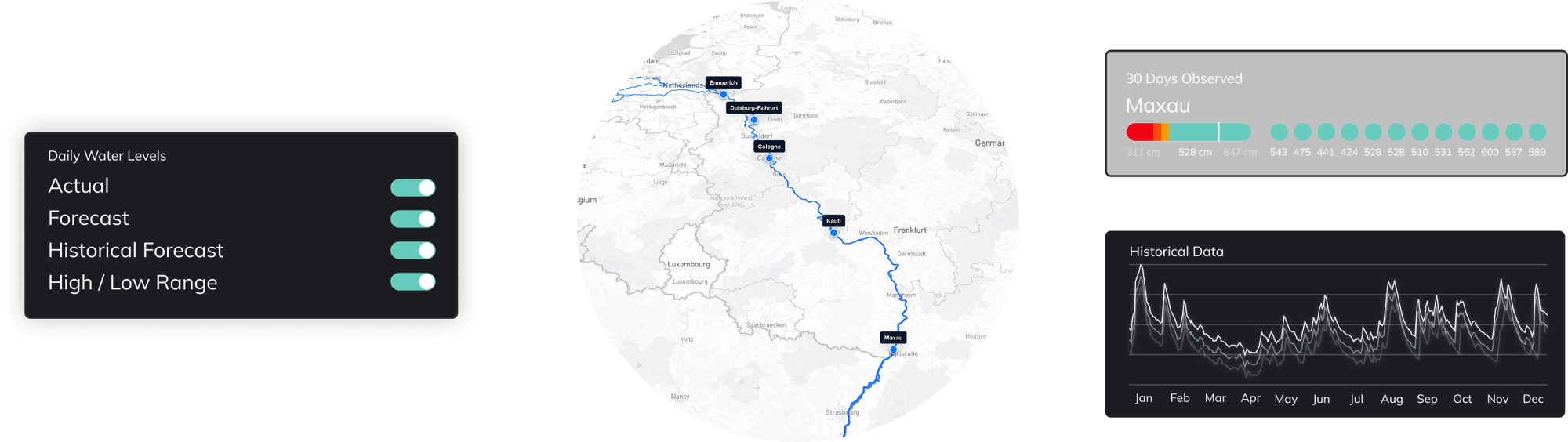
Infographic of analytics indicating RiverSats capabilitites and features
Purpose-Built Low-Water Intelligence:
ML models specifically trained and optimized for low-water scenarios—not repurposed flood forecasting systems. Predicts the actual date of minimum water levels within ±1 day accuracy.
Actual River Levels, Not Streamflow Estimates:
Forecasts the precise river level at each gauge station, giving you operational certainty rather than requiring conversion from streamflow proxies to barge capacity.
Complete Historical Intelligence:
Up to 20 years of cleansed, normalized historical data for each gauge station, enabling trend analysis, seasonal planning, and validation of forecasting accuracy.

From Weather Data to Strategic Intelligence

RiverSat's forecasting engine combines multiple data sources with specialized AI models
to deliver actionable river intelligence.

earthdaily-agri-correct-icon
Multi-Source Weather Integration
Leverages multiple weather data providers and forecasting models to maximize prediction accuracy and reliability across 28-day horizons.
Tick Icon, indicating to the user the availability of a feature.
Low-Water Optimized ML Models
Machine learning algorithms specifically trained on historical low-water events to identify patterns that trigger critical logistics constraints.
Tick Icon, indicating to the user the availability of a feature.
Station-Specific Forecasting
Individual models for each gauge station account for local hydrology, ensuring forecasts reflect actual conditions at operationally critical chokepoints.
Tick Icon, indicating to the user the availability of a feature.
Continuous Model Refinement
Ongoing validation against actual observations and retraining cycles ensure forecast accuracy remains optimal as climate patterns evolve.
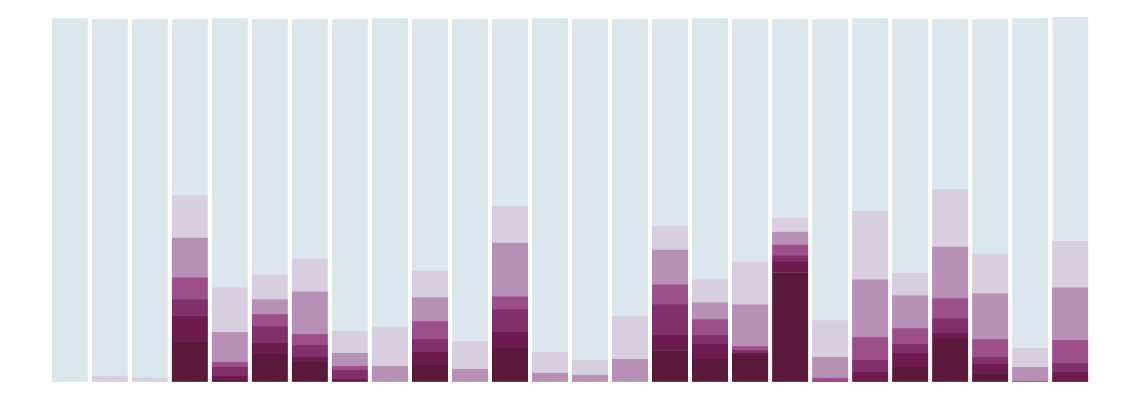
RiverSat Rhine river historical data analysis, bar chart with variable heights across years under analysis.
Historical Baseline Analysis
Compare current season forecasts against 20-year historical records to assess relative severity and inform strategic decision thresholds.

Seamless Integration with
Enterprise Planning Systems

Plan Weeks Ahead. Secure Supply. Maintain Operations.

Multiple Weather Sources:
Redundant data inputs maximize forecast reliability and reduce single-source dependency

20-Year Historical Archive:
Cleansed, normalized station records enabling seasonal benchmarking and long-term planning

Automated Alert System:
Configurable threshold notifications via email, SMS, or API webhook

Enterprise API Access:
Forecast uncertainty quantification enabling risk-adjusted decision making

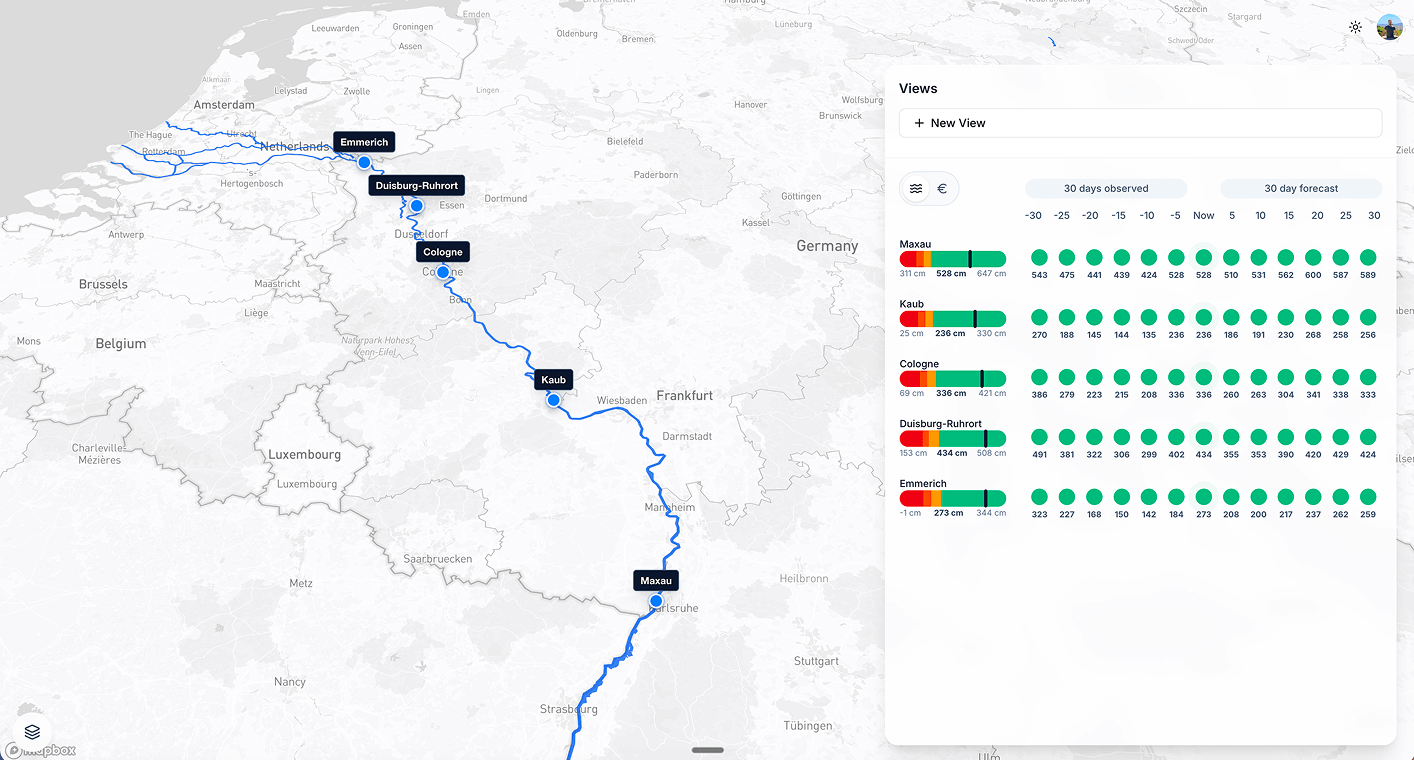
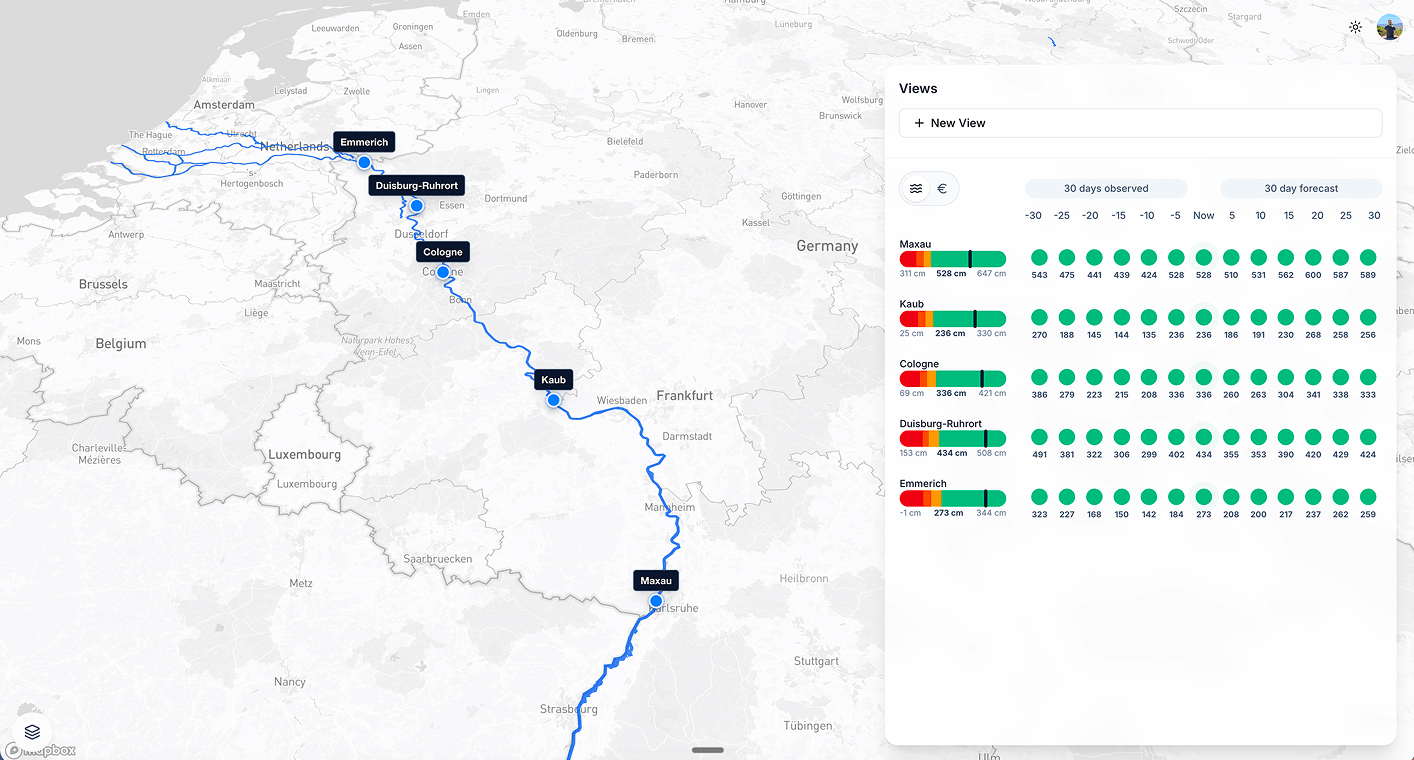
RiverSat user interface used in river monitoring for logistics

Comparative Analytics:
Current season vs. historical averages highlighting relative severity

Critical Gauge Coverage:
Maxau, Kaub, Cologne, Duisburg-Ruhrort, Emmerich on Rhine; expanding to Mississippi and Thames

28-Day Forecast Horizon:
Ongoing validation against actual observations and retraining cycles ensure forecast accuracy remains optimal as climate patterns evolve.

Daily Forecast Updates:
Fresh intelligence every 24 hours incorporating latest weather data and model outputs

±1 Day Minimum Level Accuracy:
Precise timing prediction for lowest water level enabling confident operational planning

Coverage & Expansion

Current Operations: Rhine River System

Photograph of a barge transporting mierals along the Rhine river
  • Maxau -
    Upper Rhine monitoring for Basel-Karlsruhe corridor

  • Kaub -
    Critical chokepoint for Ludwigshafen-Mannheim chemical production

  • Cologne -
    Mid-Rhine logistics hub

  • Duisburg-Ruhrort -
    Steel industry supply gateway (28M tonnes/year)

  • Emmerich -
    Lower Rhine access to Rotterdam port complex

Coming soon - Expanding Coverage

Mississippi River System - Coming 2026
Gulf Coast to Upper Midwest grain and energy logistics

Thames River System - Coming 2026
London port access and UK industrial supply chains

Who Benefits from RiverSat

Chemical Producers

Secure raw material deliveries and maintain production continuity during low-water events

Steel Manufacturers

Guarantee iron ore and coking coal supply for Duisburg operations and regional mills

Power Generators

Build strategic coal stockpiles maintaining baseload capacity and grid commitments

Barge Operators

Optimize fleet deployment and structure premium pricing based on advance capacity forecasts

Logistics Providers

Coordinate multi-modal transport and lock in rail / truck alternatives before emergency premiums hit

Procurement Teams

Negotiate favorable contracts 4 weeks ahead of supply constraints while competitors scramble

Online Documentation & Tutorials:
Step-by-step onboarding for exploration teams.

View Knowledgebase

Plan with Confidence

Join industry leaders using RiverSat to transform River uncertainty into strategic advantage and protect operations from low-water disruptions.

FAQs

Built for operational environments where every change matters and every hour counts.

EarthDaily's sensors capture data beyond the visible spectrum, reveaRiverSat is operational on the Rhine River with coverage at five critical gauge stations: Maxau, Kaub, Cologne, Duisburg-Ruhrort, and Emmerich. Coverage for Upper Mississippi River with stations at St. Paul, MN; Winona, MN; Camanche, IA; and Grafton, IL. Expansion to the Thames River system is planned for 2026.
ling concealed activities invisible to standard imagery. Multispectral data enables detection of camouflaged structures through spectral signature analysis, identification of materials and surface characteristics, and discovery of environmental disturbances that indicate human activity even when visual changes are minimal.
RiverSat achieves ±1 day accuracy for predicting the actual date of minimum water levels. This precision enables confident operational planning for time-critical logistics and procurement decisions.
Public services typically forecast streamflow (requiring conversion to river levels) with 10-day accuracy limits. RiverSat forecasts actual river levels at specific gauge stations with 28-day reliable horizons using ML models optimized specifically for low-water events.

Yes. RiverSat provides RESTful API access in addition to CSV data exports for seamless integration with procurement, logistics, and ERP systems. Technical documentation and integration support are included.
RiverSat provides up to 20 years (1995-present) of cleansed, normalized historical data for each gauge station, enabling trend analysis, seasonal benchmarking, and validation of current season forecasts against historical patterns.
Forecasts are updated daily at approximately 10:00 AM CET and leverage the most recently released ensemble weather forecasts. Current river level values are refreshed every 15 minutes in the application (and API) providing users with near real-time logistics intelligence.
RiverSat tracks forecast evolution and can alert users when significant changes occur in predicted minimum levels or timing. This enables dynamic adjustment of procurement and logistics strategies as conditions evolve.
No. RiverSat's ML models are specifically optimized for low-water event prediction—the scenarios that devastate industrial logistics. For flood forecasting, alternative specialized systems are more appropriate.