
World in 10 Overview

01

USA - Is corn harvest still lagging in the western Corn Belt?

YES

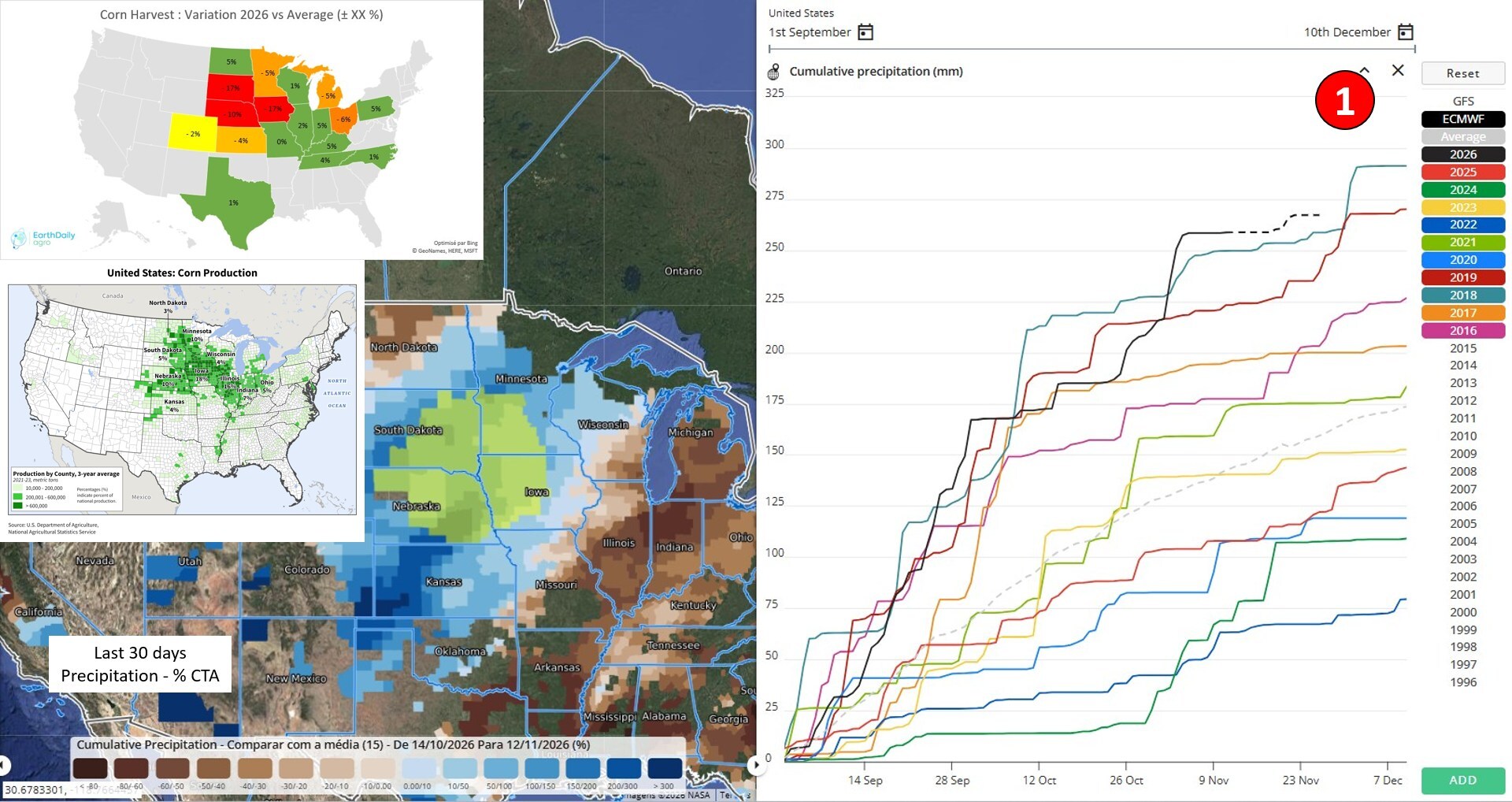
According to the USDA, corn harvest remains well behind average in Iowa and South Dakota (-17 points) and Nebraska (-10 points), three states that account for roughly one-third of U.S. corn production. Rainfall over the past 30 days has been well above average ① across these areas, while the eastern Corn Belt stayed mostly dry, where harvest is at or ahead of the usual pace. Cumulative precipitation since September 1 is among the highest of the past 10 years, comparable only to 2018. The ECMWF forecasts limited additional rainfall over the coming days, which should help harvest catch up.

Agri466
02

Brazil - Is soil moisture in Mato Grosso finally expected to recover?

YES

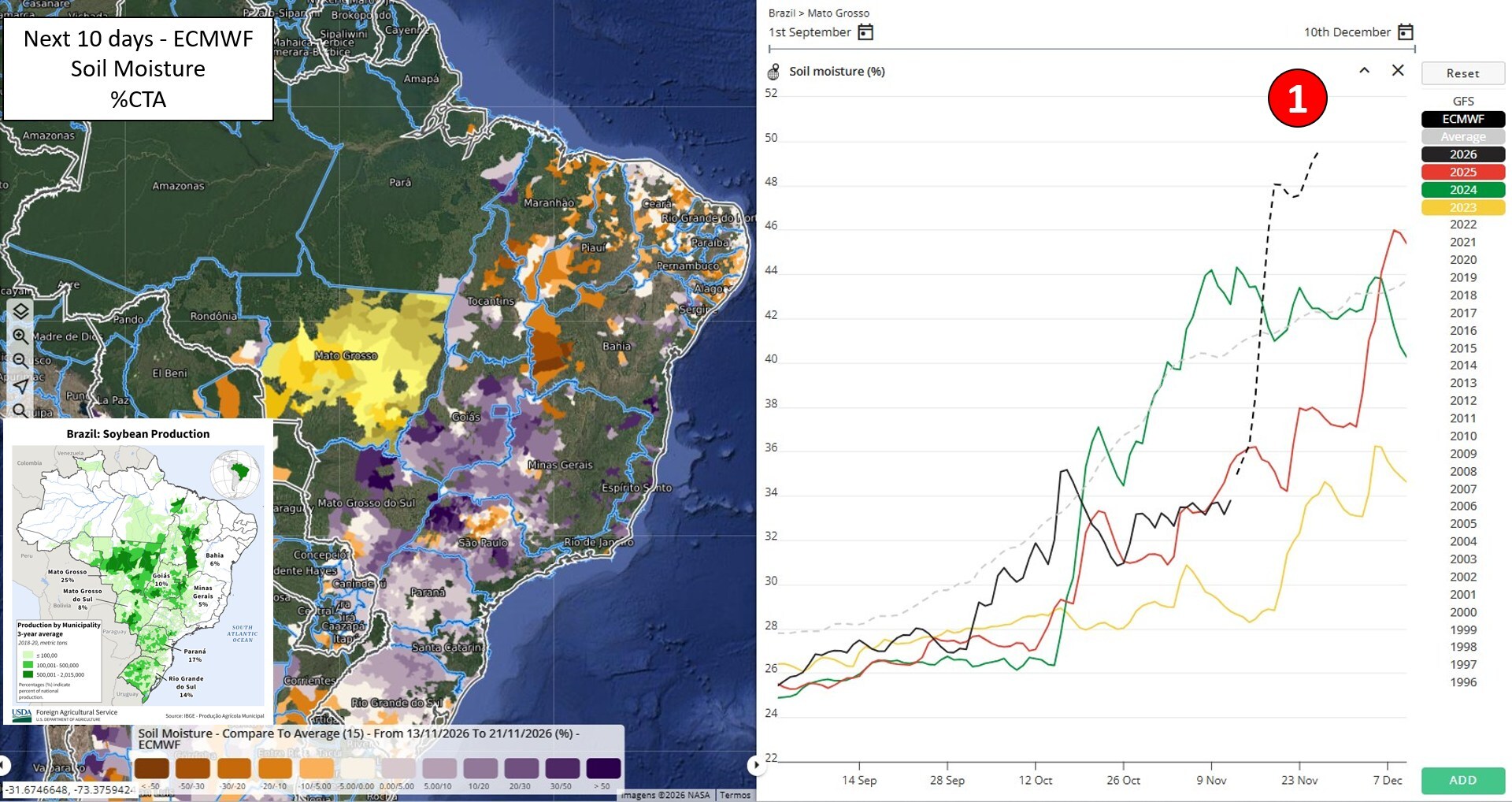
Soil moisture in Mato Grosso remains below average, close to 2025 levels, as the recovery expected in early November has not yet materialized ①. The ECMWF now forecasts a sharp increase by November 21, lifting levels well above average and above recent years, which would favor soybean establishment. Conditions are also expected to improve across Goiás, Minas Gerais and Mato Grosso do Sul, while below-average soil moisture persists across much of Matopiba, particularly in Maranhão, Piauí and western Bahia.

Agri468
03

Brazil - Is rainfall expected to ease dry conditions in the North/Northeast?

YES

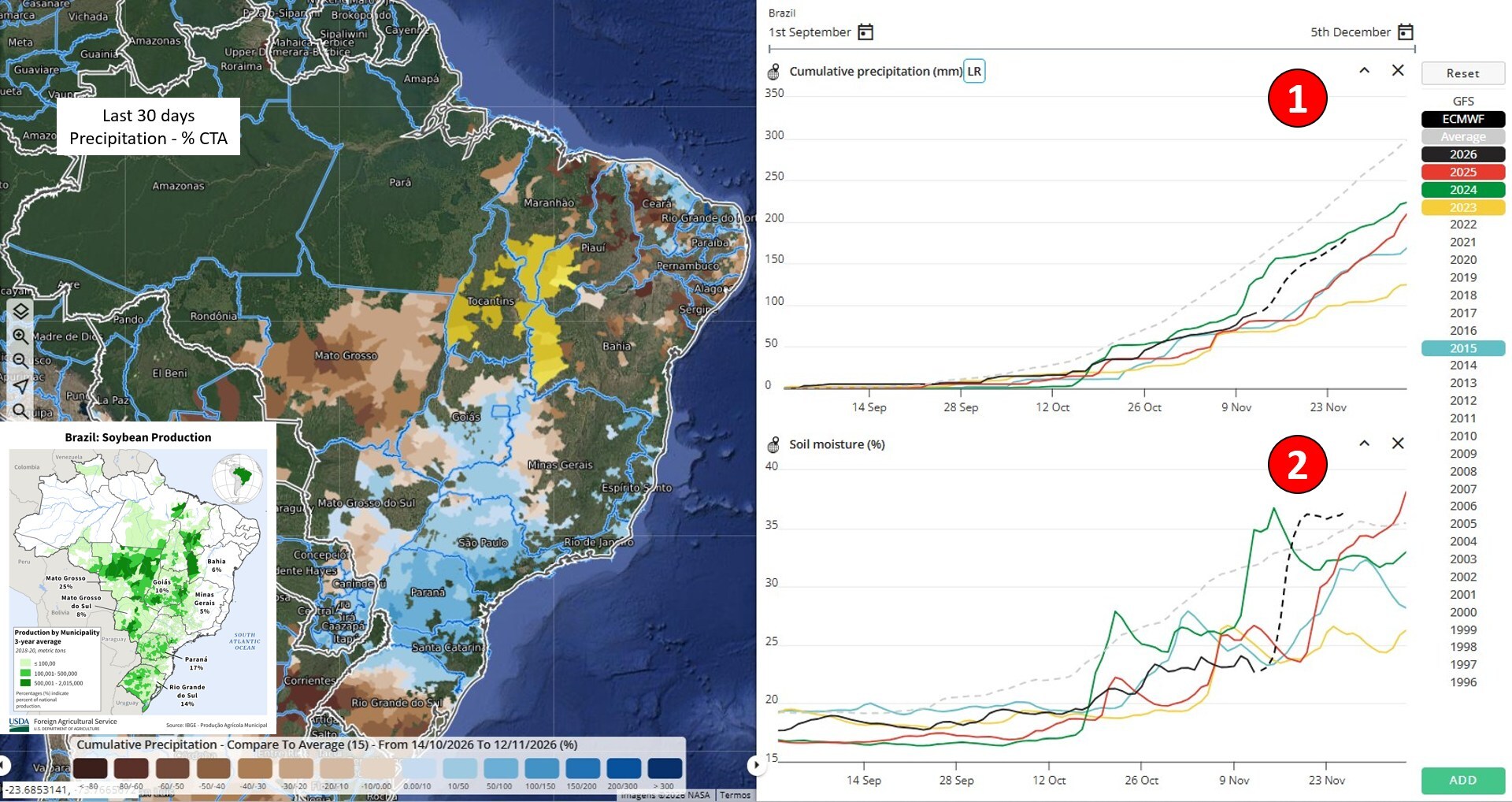
In the North and Northeast of the country, cumulative precipitation since September and soil moisture remain below average, at levels similar to 2015 and 2025 ①. Rainfall over the past 30 days has been well below average across the region and Mato Grosso, in contrast with wetter conditions further south. The ECMWF forecasts significant rainfall over the coming days, which could bring soil moisture ② back above average by late November and improve conditions for soybean planting and establishment.

Agri473
04

Brazil - Do weather models agree on rainfall over the next 10 days?

Partially

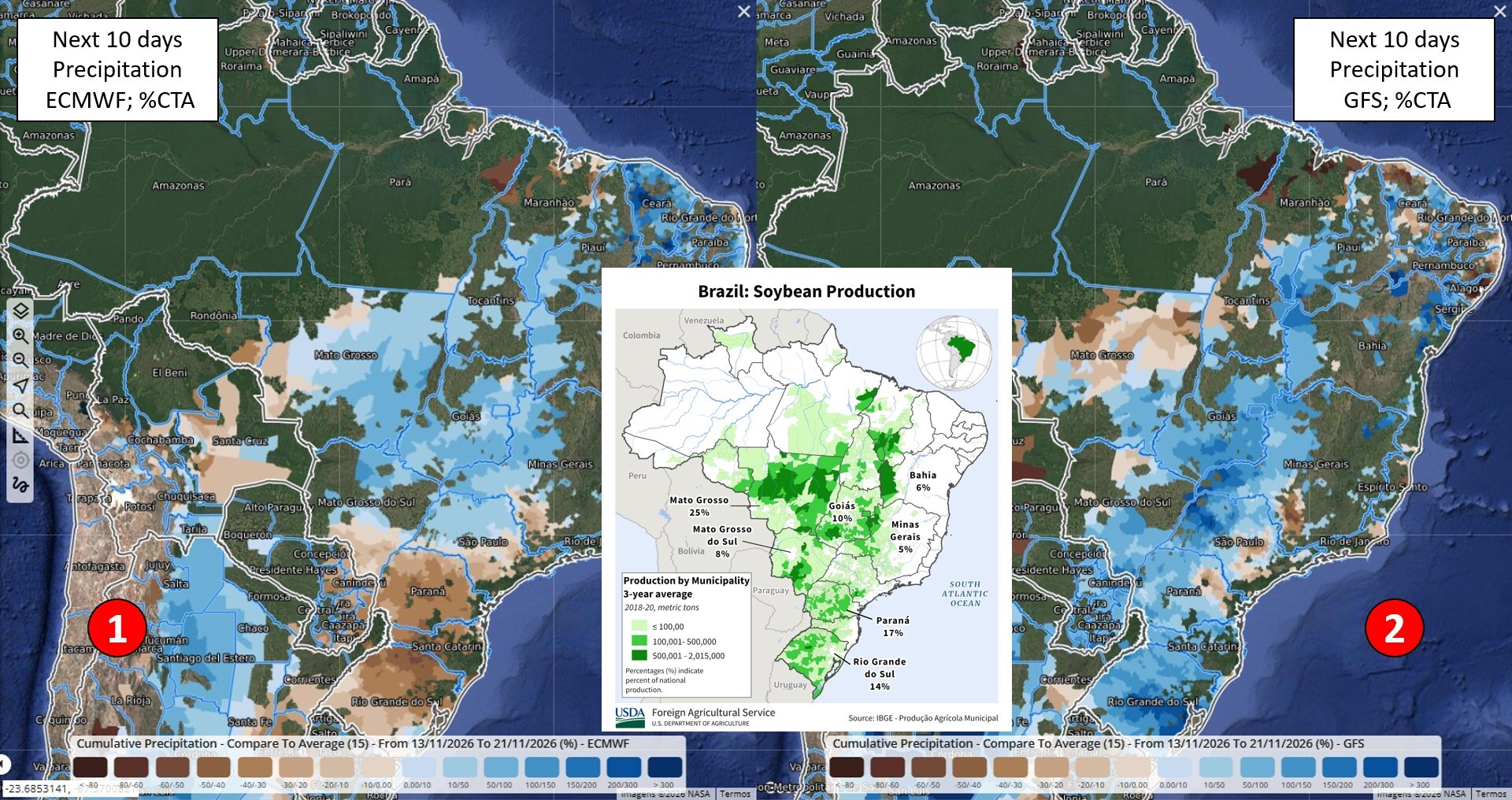
Both the ECMWF ① and the GFS ② forecast above-average rainfall across much of the Center-North, including Goiás, Minas Gerais, Tocantins and western Bahia. However, the models diverge in the South. The ECMWF points to below-average rainfall in Paraná, Santa Catarina and Rio Grande do Sul, which would favor wheat harvest and summer crop planting after recent excess rain, while the GFS keeps conditions wet. In Mato Grosso, the GFS is also less favorable than the ECMWF, with below-average rainfall in central and western parts of the state.

Agri475
05

Brazil - Could rainfall slow wheat harvest progress?

Yes

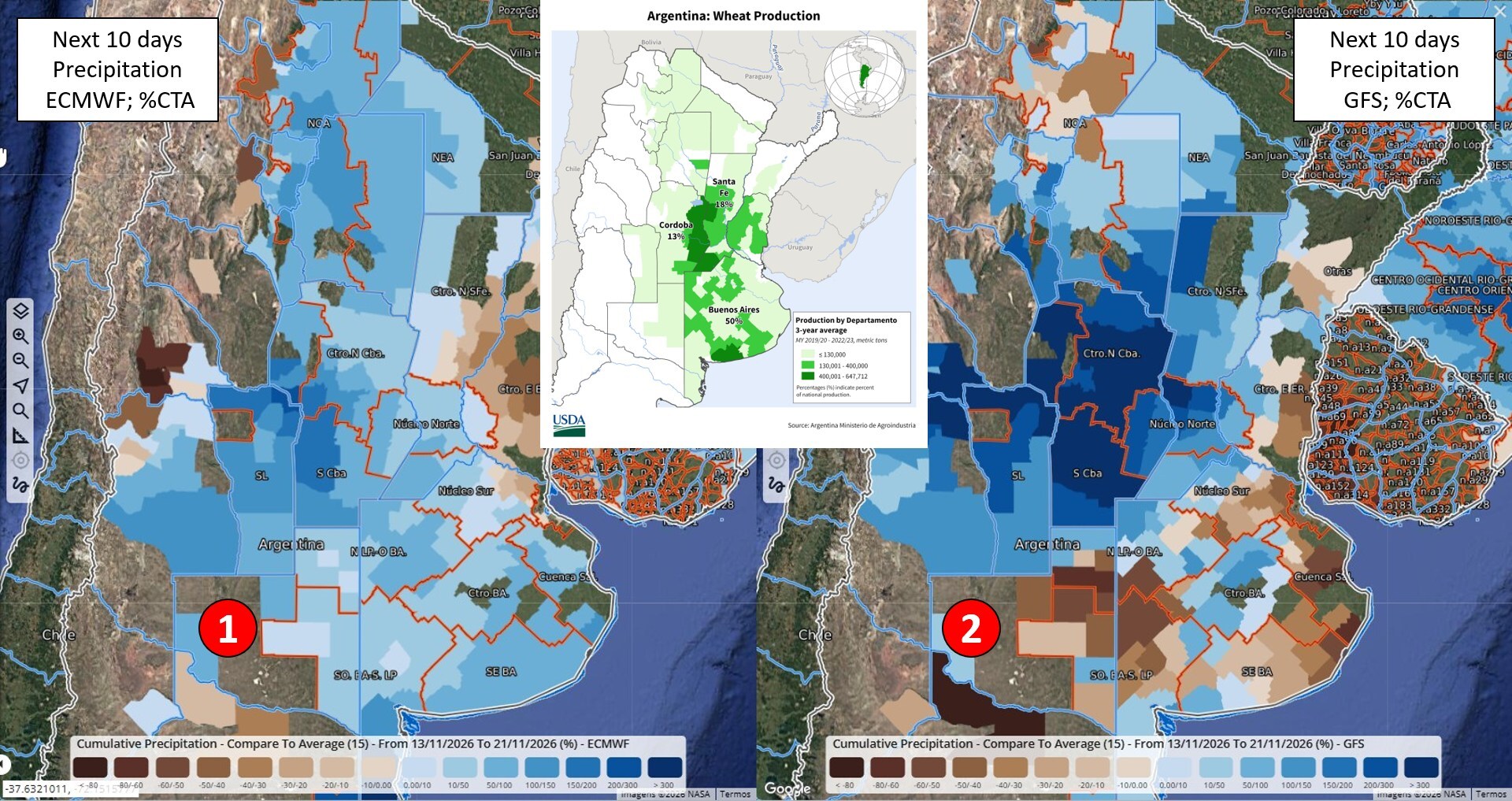
Both the ECMWF ① and the GFS ② forecast above-average rainfall across northern and central areas, including Córdoba and Santa Fe, with particularly heavy accumulations expected by the GFS. These conditions could slow the wheat harvest, which is starting in the north of the country, while supporting corn and soybean planting. In Buenos Aires, which accounts for half of national wheat production, the models diverge: the ECMWF points to above-average rainfall, while the GFS forecasts drier conditions across much of the province.
Agri477
06

Argentina - Are soil moisture conditions favorable for corn and soybean planting?

Yes

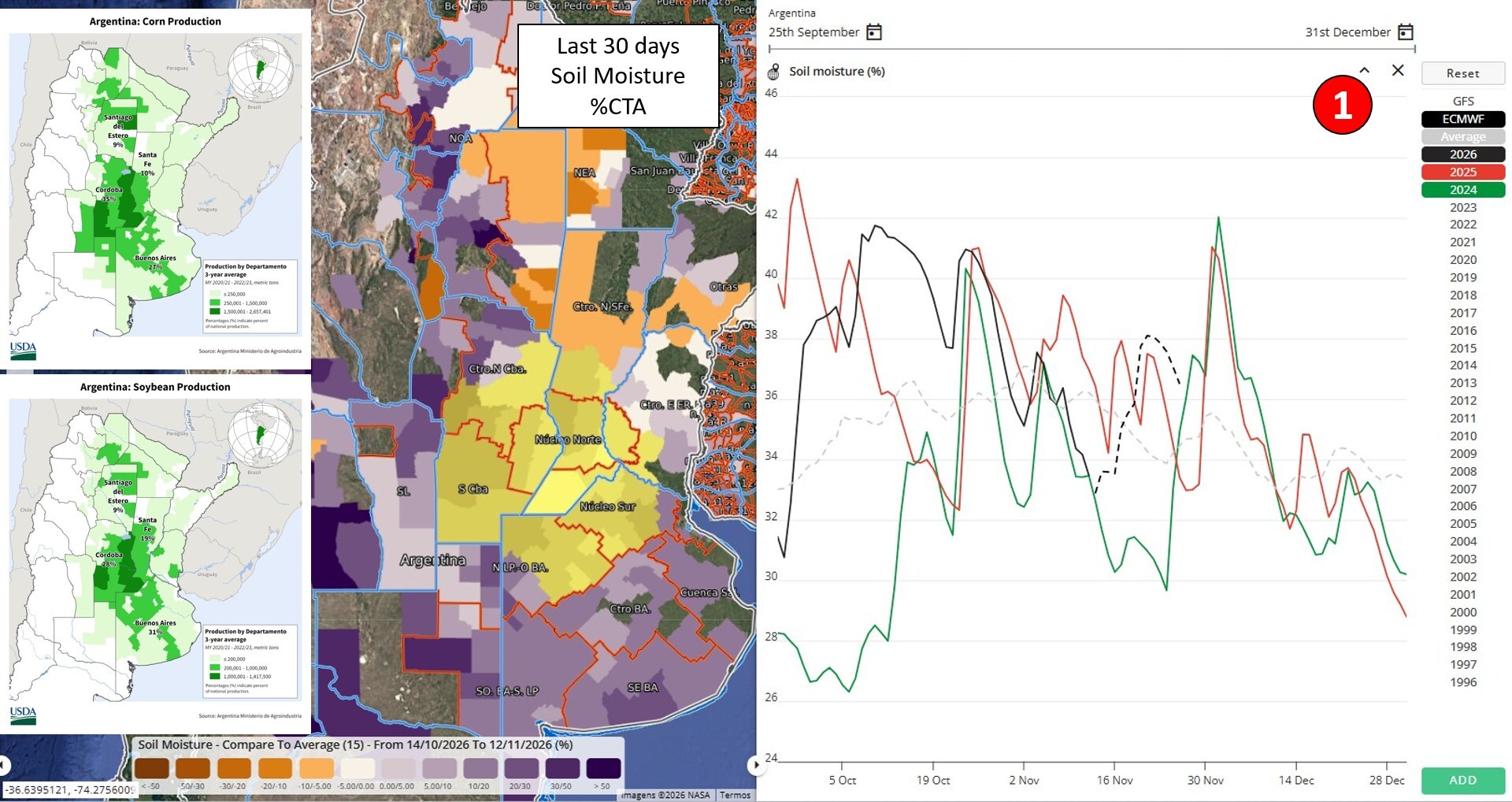
Soil moisture in the core corn and soybean region has declined in recent days and is now below average, after remaining above average for most of October ①. The ECMWF forecasts a recovery to above-average levels by late November, which should support planting and early crop establishment. Over the past 30 days, soil moisture remained above average across much of Buenos Aires and La Pampa, while drier conditions prevailed in northern Santa Fe and the northeast.

Agri479
07

Australia - Is rainfall threatening winter crop quality at harvest in the east?

Yes

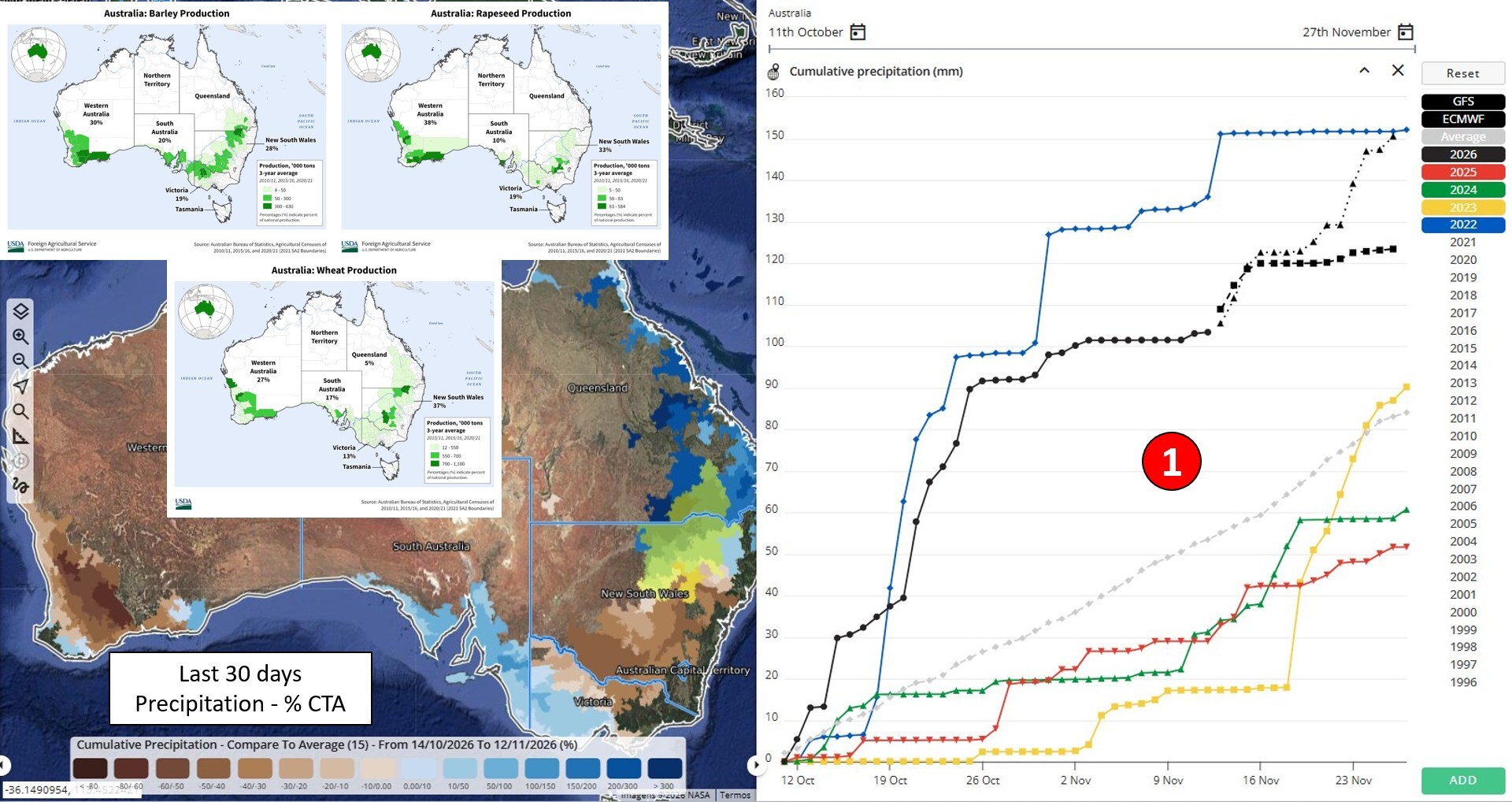
In northern New South Wales and southern Queensland, cumulative precipitation since mid-October is more than double the average, second only to 2022 among recent years ①. Both the GFS and the ECMWF forecast further rainfall over the coming days, increasing the risk of harvest delays and quality downgrades for wheat and barley. In contrast, drier conditions across Western Australia and much of South Australia ② should favor harvest progress.
Agri481
08

Europe - Will soil moisture deficits ease over the coming days?

PARTIALLY

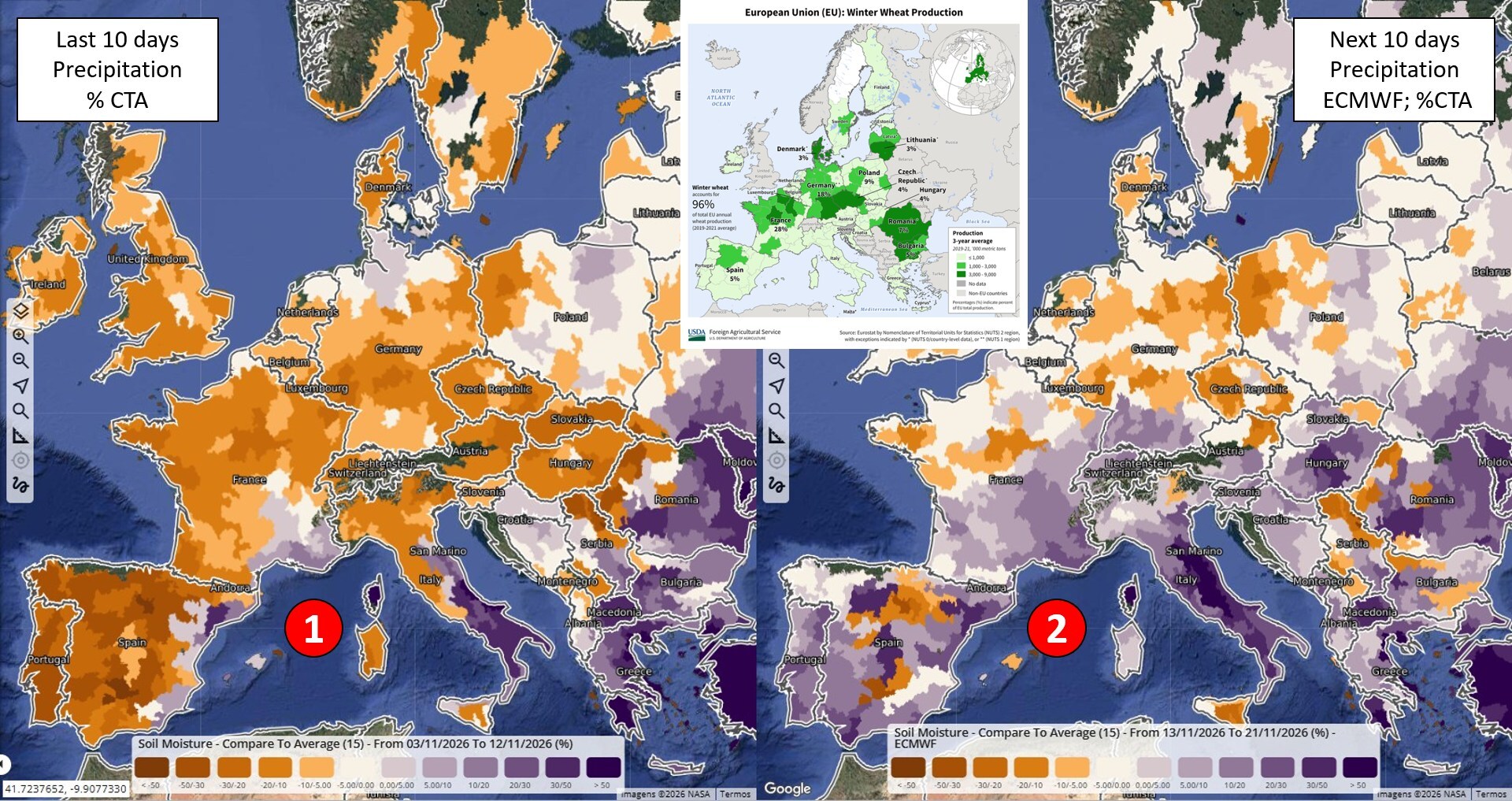
Soil moisture has remained below average over the last days across most of western and central Europe, including France, Germany, Spain and Poland, while conditions were wetter in Romania, Bulgaria and Greece ①. The ECMWF forecasts a significant improvement over the coming days in France, Spain and Hungary ②, which should support rapeseed and winter cereal establishment. However, deficits are expected to persist across Germany, Poland and the Czech Republic, which together account for more than a quarter of EU winter wheat production.

Agri483
09

Russia - Are winter wheat conditions improving before dormancy?

Partially

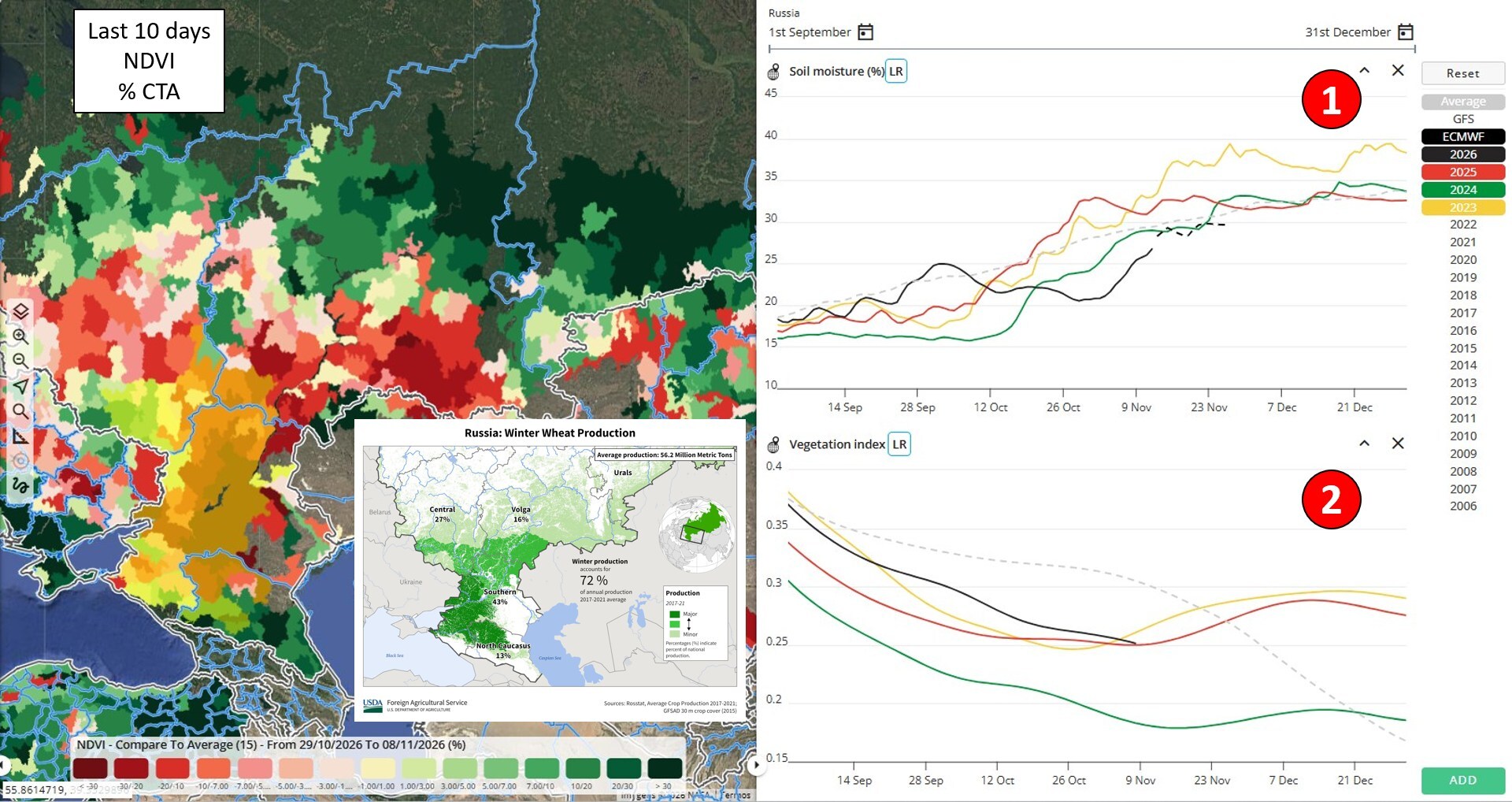
Soil moisture in southern Russia, which accounts for more than half of the country’s winter wheat production, has risen sharply in recent days after remaining well below average through October ①. The ECMWF forecasts levels close to average by late November. Vegetation indices, however, remain below average ②, at levels similar to 2023 and 2025 but above 2024. Further north, below-average NDVI has also been observed over the past 10 days across much of the Central and Volga districts.

Agri485
10

India - Will rainfall support wheat sowing over the coming days?

No

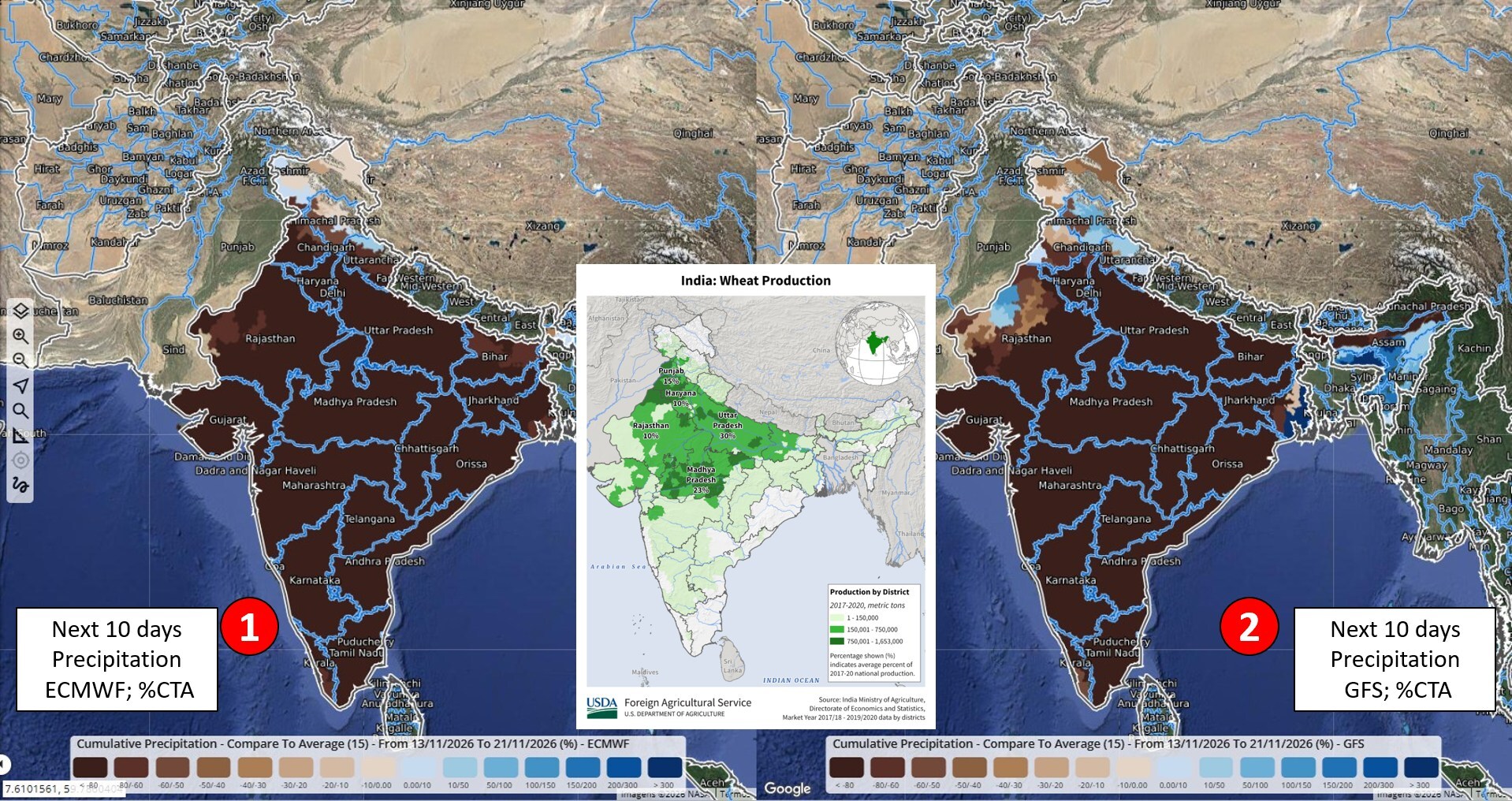
Both the ECMWF ① and the GFS ② forecast well-below-average rainfall across virtually all of India over the next 10 days, including Uttar Pradesh, Madhya Pradesh, Punjab, Haryana and Rajasthan, which together account for nearly 90% of national wheat production. Rainfall is typically low at this time of year and most wheat is irrigated. Even so, the lack of rain will keep sowing dependent on residual soil moisture and irrigation reserves, both limited after a below-average monsoon. To monitor! 

Agri488

Subscribe to World in 10