

.jpg?width=289&height=168&name=Data%20Use%20cases%20(1).jpg)
Wildfire Risk Intelligence:
Forward-Looking Intelligence in Fire-Prone Markets
As standard carriers exit fire-prone markets, the opportunity is real but the data is the bottleneck. Traditional CAT models built on historical burn scars cannot tell an underwriter whether a specific property is insurable today given current fuel loads and shifting fire regimes.
Find the Insurable Risk Your Competitors Are Walking Away From
Ascend's wildfire risk intelligence fills that gap. EarthDaily's proprietary satellite data and forestry science deliver a fuels-based, forward-looking wildfire exposure risk score at 20 to 30m resolution, 15 to 50 times more granular than competing products. Instead of painting entire geographies as uninsurable, Ascend identifies the properties within high-risk zones that are defensible, maintained, and positioned away from the highest fuel concentrations.
The result: carriers who grow profitably in fire-prone markets by writing the risks everyone else is walking away from, with the data to prove every decision to reinsurers.
Capabilities
The Ascend Advantage:
Vertically Aligned Wildfire Intelligence
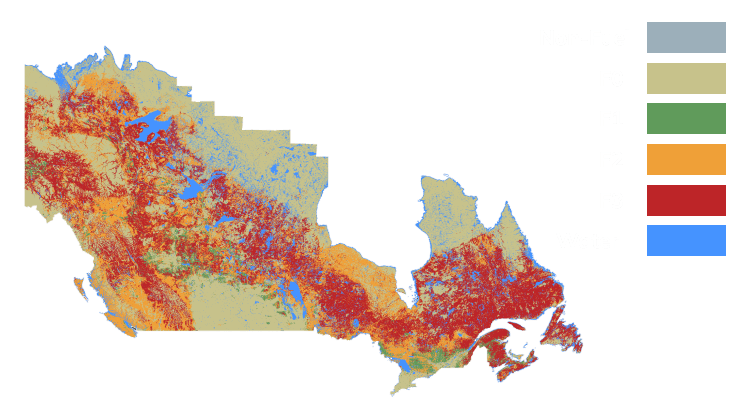
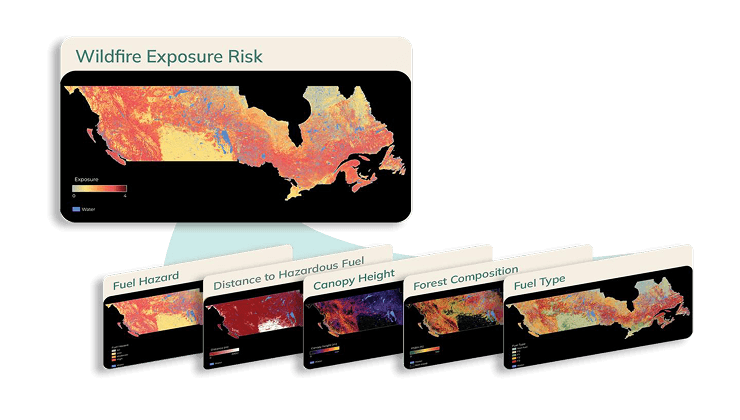
Fuel drives wildfires. Ascend's wildfire risk score is built on direct satellite observation of fuel hazard, distance to hazardous fuel, canopy height, forest composition, and fuel type. This fuels-based approach reflects current conditions rather than historical loss patterns, providing a forward-looking assessment that stays relevant as landscapes change.
EarthDaily's satellite constellation continuously monitors forest and vegetation condition over large areas, detecting changes that directly affect wildfire risk:
- Identifies forest and plant health issues driven by invasive insects and biotic stressors before they are visible on the ground
- Quantifies plant vigor using photosynthesis-related indices, providing an objective signal of declining health and rising mortality risk
- Tracks leaf-on/leaf-off phenology to map dead and dying stands, linking canopy status directly to evolving fuel loads
- Measures soil moisture patterns that influence ignition potential and fire behavior
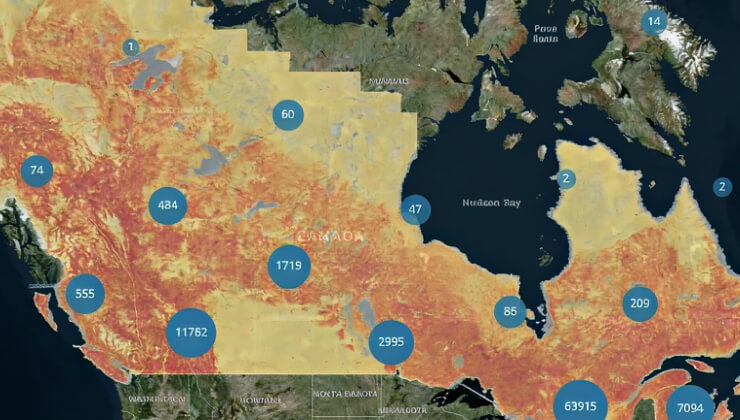
Globally scalable wildfire risk probability modeling that integrates fuel conditions, topography, and weather patterns to assess ignition likelihood and fire spread. EarthDaily satellite imagery creates detailed maps of vegetative fuel loads, canopy density, and combustible material distribution.
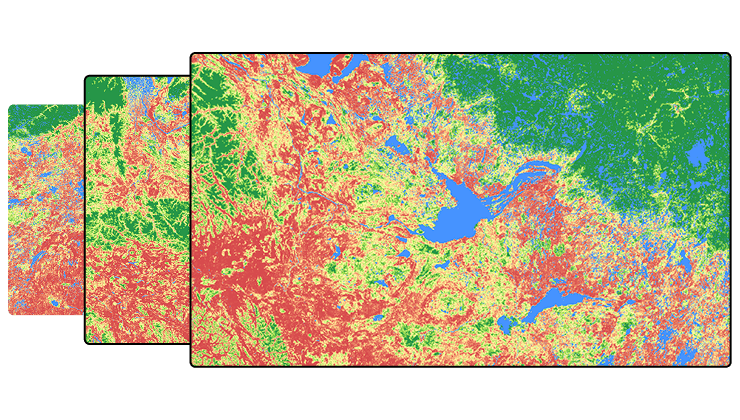
Identifies areas where wildfire probability or fuel hazard has shifted over time, enabling portfolio managers to track evolving exposure and adjust underwriting strategies between annual model refreshes.
Real-World Impact
Use Case:
E&S Carrier Capturing Retreating Market Share
Challenge:
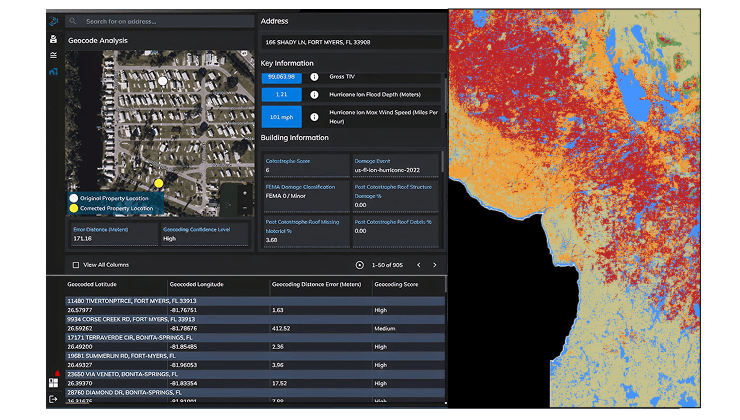
Standard carriers are exiting California, Colorado, and British Columbia. Wildfire-exposed submissions are up significantly, but the carrier's data workflow cannot keep pace. Each submission requires pulling wildfire scores from one vendor, flood data from another, and property characteristics from a third, then manually reconciling inconsistent geocoding across all of them. The underwriting team is stretched and the process does not scale to capture the opportunity.
Solution:
Ascend's proprietary wildfire data identifies insurable properties within broadly high-risk zones that competitors are declining. Because flood, hail, and other peril data from curated partners lives in the same platform against the same geocoding baseline, underwriters get a complete multi-peril picture in a single query. The team eliminates the manual reconciliation step entirely, reducing time per submission and improving consistency across the book.
Outcome:
The carrier turns around wildfire-exposed submissions faster, writing profitable policies on properties that competitors reject based on coarse zone-level scores. Reinsurance negotiations strengthen because the carrier demonstrates property-level, cross-peril underwriting data rather than estimates built from stitched-together spreadsheets. Submission volume that would have overwhelmed the previous workflow becomes manageable within existing headcount.
Use Case:
MGA Without Internal Modeling Infrastructure
Challenge:
The MGA operates lean with no internal GIS team, CAT modeling department, or dedicated data science resources. It competes against larger carriers with all three and feels the gap when it comes to pricing consistency, capacity provider confidence, and underwriting authority renewals. Without institutional-grade analytics, the MGA struggles to demonstrate the rigor that capacity providers increasingly demand.
Solution:
Ascend provides institutional-grade wildfire analytics built on the same forestry science that utility operators and government agencies use for high-stakes operational decisions. Curated partner data covers every other peril in the book. The platform is designed for underwriters to operate without technical training, giving the MGA the analytical depth of a specialist without the overhead of building internal teams.
Ascend provides institutional-grade wildfire analytics built on the same forestry science that utility operators and government agencies use for high-stakes operational decisions. Curated partner data covers every other peril in the book. The platform is designed for underwriters to operate without technical training, giving the MGA the analytical depth of a specialist without the overhead of building internal teams.
Outcome:
The MGA demonstrates data-backed risk selection to capacity providers across every peril, not just wildfire. Underwriting authority renewals are supported by evidence of property-level precision and consistent pricing methodology. The team operates with institutional-grade analytics at a fraction of the cost of building internal modeling capabilities.
The MGA demonstrates data-backed risk selection to capacity providers across every peril, not just wildfire. Underwriting authority renewals are supported by evidence of property-level precision and consistent pricing methodology. The team operates with institutional-grade analytics at a fraction of the cost of building internal modeling capabilities.
FAQs
What is Ascend's wildfire risk intelligence?
Ascend's wildfire risk intelligence is a fuels-based, forward-looking exposure risk score delivered at 20 to 30m resolution through the Ascend SaaS platform. It is built on proprietary satellite data from the EarthDaily Constellation and EarthDaily's forestry remote sensing expertise, assessing current fuel conditions, canopy health, and vegetation characteristics rather than relying on historical burn scar models.
How does Ascend's wildfire data differ from CAT models?
CAT models are probabilistic and retrospective. They estimate aggregate losses across simulated futures based on historical loss patterns. They were not designed to assess whether a specific property is insurable today given current fuel loads. Ascend fills that gap with direct satellite observation of the conditions that drive wildfire behavior, providing property-level precision that complements rather than replaces existing CAT model workflows.
What resolution does Ascend's wildfire data provide?
Ascend delivers wildfire risk intelligence at 20 to 30m resolution, which is 15 to 50 times more granular than competing products. This resolution enables underwriters to differentiate individual properties within broadly high-risk zones, identifying insurable risks that coarser scoring systems would reject.
How often is wildfire risk data updated?
Daily satellite capture from the EarthDaily Constellation enables monthly updates to wildfire risk scores and fuel hazard data. This provides a faster refresh cadence than solutions that rely on annual or semi-annual data updates, ensuring risk assessments reflect recent changes in vegetation, fuel loads, and forest conditions.
Does Ascend replace our existing CAT model?
No. Ascend is designed to complement existing CAT models, not replace them. It fills specific gaps that probabilistic models were not designed to address, particularly on wildfire where current fuel conditions matter more than historical loss patterns. Ascend layers into existing workflows without requiring a rip-and-replace of established tools.
What geographies does Ascend's wildfire intelligence cover?
EarthDaily provides the only Canada-wide 20m resolution wildfire map. Dynamic AI Wildfire Intelligence is globally scalable. [VERIFY: Confirm current US coverage, specific state availability, and expansion timeline for additional geographies.]
Can non-technical underwriters use Ascend's wildfire data?
Yes. Ascend is built for underwriters, not GIS analysts or data scientists. The platform includes LLM-powered natural language query capabilities that allow non-technical users to access complex wildfire risk data conversationally. Property-level wildfire scores are accessible through the Ascend web interface without specialized training.
How does Ascend help with reinsurance negotiations?
Carriers using Ascend can demonstrate property-level, cross-peril underwriting data to reinsurers rather than portfolio-level estimates. The combination of forward-looking wildfire intelligence, validated geocoding, and multi-peril analytics provides the data-backed evidence that reinsurers increasingly require to assess cedant risk selection quality.
See How Ascend Transforms Wildfire Underwriting
Discover how Ascend's fuels-based wildfire intelligence can strengthen risk selection in fire-prone markets. EarthDaily offers a 3-month proof-of-value engagement that benchmarks Ascend against your current workflow on speed, accuracy, and risk selection quality.
- Evaluate your portfolio with property-level wildfire risk scores at 20 to 30m resolution
- Compare Ascend's fuels-based scoring against your current wildfire data on a subset of your book
- See the properties your competitors are missing within high-risk zones you may be declining broadly
- Demonstrate to reinsurers how data-backed wildfire risk selection improves portfolio quality