
.jpg?width=289&height=168&name=Data%20Use%20cases%20(1).jpg)
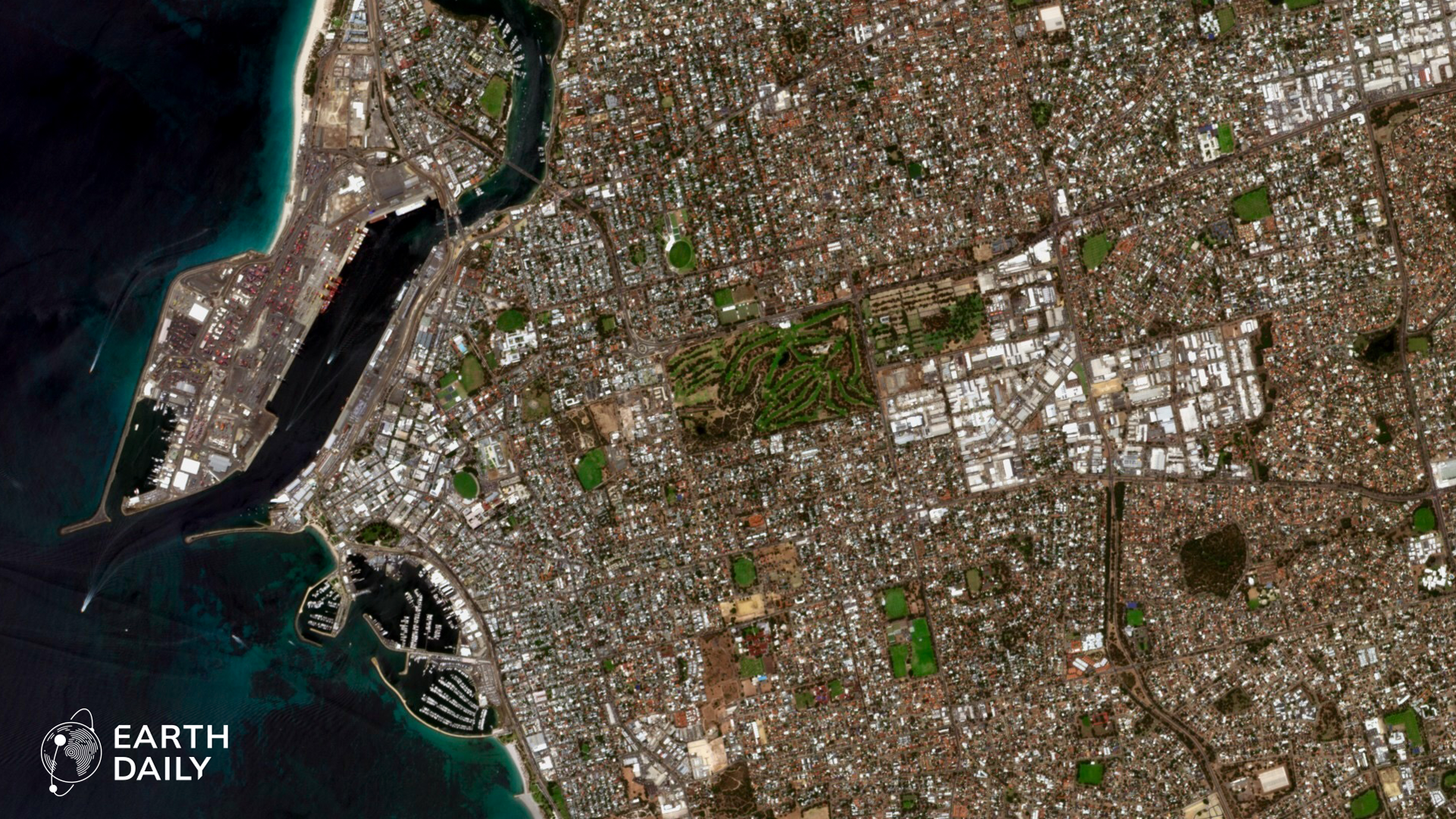
Booyeembara Park, Perth, Australia captured by EarthDaily’s EDC-01 in February 2026.
Achieving daily global coverage is only meaningful if the measurements behind it are scientifically reliable. Maintaining that standard requires continuous calibration, validation, and engineering discipline to preserve radiometric accuracy, geometric stability, and signal quality across a multi-satellite Earth observation constellation. This is part of a four-part series adapted from a feature first published in SpaceNews: Engineering Behind EarthDaily: Solving for Global Daily Coverage, Scientific Quality, and High-Spectral Diversity.
We designed EarthDaily to operate as a trusted digital infrastructure like other satellite technologies such as GPS and weather data, but for Earth observation — consistent, reliable, frequent, and repeatable. To do this requires achieving Sentinel-2 and Landsat-like scientific quality with a daily global revisit. In practical terms, that means operating under a defined Service Level Agreement (SLA) committing us to measurable thresholds for scientific performance.
In science missions, quality requirements are specific and backed by rigor: radiometric accuracy better than 5 percent, geometric quality better than 10 meters, and signal-to-noise ratios above 100 for most types of ground cover.
At EarthDaily, we set the bar high and design to these same measures:
- Radiometric accuracy: Better than 5 percent. This comes down to sensor design, pre-launch calibration, and in-orbit calibration, with satellite-to-satellite consistency better than half that. Every day we image the Earth’s landmass at the same time of day as many science missions, meaning their imagery becomes continual reference for our ongoing calibration and validation.
- Geolocation accuracy: Better than 10 meters (expect less than 5m in most situations). This is driven by focal plane and optical distortion calibration, basemap quality, and physics-based processing (not rubber sheeting) with AI-assisted ground control to inform our satellite and sensor model. We also create our own basemaps using rigorous global bundle adjustment to minimize errors and tie our maps with extreme precision.
- Signal-to-noise ratio (SNR): Better than 100 for most types of ground cover. We use a pushbroom sensor with Time Delayed Integration (TDI) to integrate signals across multiple lines (versus one), enabling high SNR and accurate measurement of subtle signals on the ground. This is the same sensor technology approach used by Sentinel-2 and Landsat and is well suited for scientific measurements.
Maintaining an SLA for scientific quality is not a one-time check. It requires continuous calibration and validation, with regular reporting that builds trust with customers.
Early imagery from the first EarthDaily satellite (EDC-01) can be viewed here.
Calibration isn’t a Checkbox
For EarthDaily, pre-launch characterization is not a single lab session with a broadband light source. It is a carefully designed campaign to map the response at every wavelength using tunable lasers conducted alongside instrument development, with NIST-traceable instrumentation.
That requires:
- Tunable laser systems
- Specialist physicists
- Controlled calibration facilities
- Detailed uncertainty modeling
We chose to work with world-class calibration partner L-1 Standard and Technology Inc. because this level of rigor — truly understanding sensor performance at a fundamental level — is what makes data comparable across time, satellites, and geography. Their experience includes trusted scientific missions at NASA and NOAA, and that rigor is necessary to meet our customer requirements.
The result is analytics that do not quietly degrade as sensors drift, viewing angles vary, imaging time shifts, or the constellation evolves. Calibration is not overhead. It is the foundation of trust.
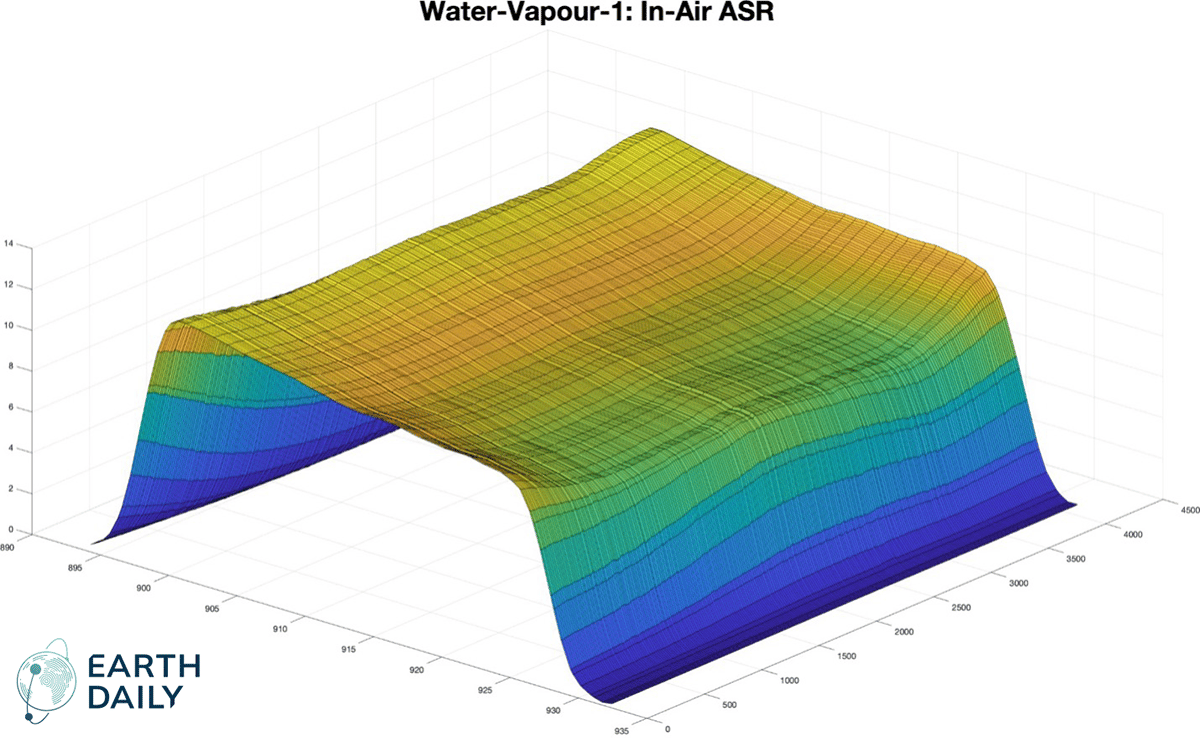
EarthDaily’s radiometric calibration of our specialized water vapor versus spectral frequency. This band’s sole purpose is to improve the quality of our products not as data for a customer to use.
Thermal: Where Physics is Unforgiving
Thermal imaging adds another layer of complexity.
In thermal, everything is temperature dependent until characterized. Everything is stray light until proven otherwise. Every deviation between model and reality must be measured and reconciled.
Detecting a thermal signal is easy. Measuring it accurately — in a stable fashion and consistently across environments — is not.
We have worked closely with our partners such as ABB and INO to deeply characterize the imager’s behavior, supported by the Canadian Space Agency and using innovative in-orbit calibration efforts.
We have analyzed millions of global calibration sites to maintain stability over time. We cross-calibrate our system daily against eight science missions. Any drift, no matter how small, is monitored continuously and corrected.
Thermal performance is not about producing dramatic images. It is about ensuring that a temperature change measured today means the same thing six months, or ten years, from now.
For many commercial space companies, the ground sampling distance and the spatial resolution are quite different, which leads to confusing results. Left: Sentinel-2 is a true 10m system;Right: EarthDaily is a true 5m system (unsharpened). Can clearly see separation of feature that is 2.6m apart in the high-resolution image from Google Earth (zoom image)
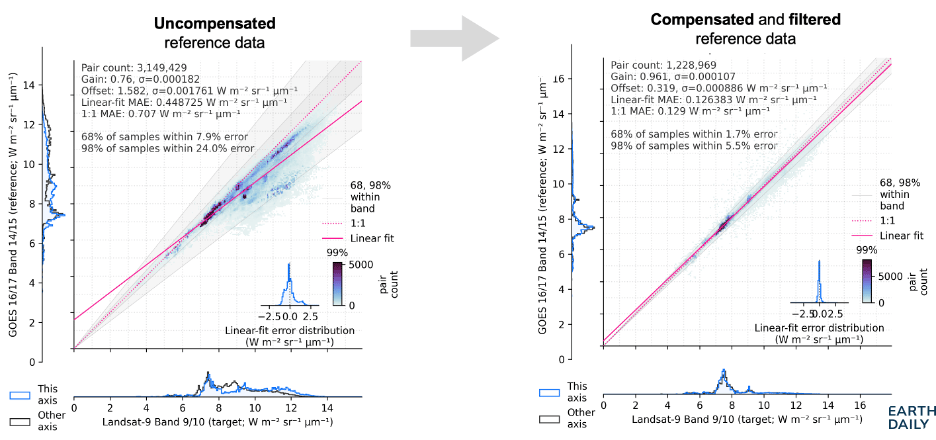
Validating cross calibration between GOES and Landsat-9. Compensating for spectral differences, atmospheric changes, viewing angles is complex and we rigorously model effects so that we can accurately and continuously calibrate our mission.
Manufacturing: ‘Good Enough’ isn’t Good Enough
Space hardware rarely behaves exactly as expected. Bonding tolerances, structural stress, alignment deviations, subtle deformations — these are the realities of building precision systems.
In one instance, rigorous testing identified excess stress in part of the optical system, causing minute deformation and a measurable impact on image sharpness. To detect even the smallest anomalies in resolution, we developed automated validation processes with ABB to precisely measure sensor performance.
The degradation would have been subtle. It may have been difficult for many users to notice. It would have been faster to keep moving forward and launch.
Instead, we stopped, redesigned, and requalified as necessary.
That is the difference between iteration-driven missions and measurement-driven missions. In a fail-fast world, you fly and fix later. In a science-class mission, you fix before flight, because reliability defines value. In other missions, the strategy is to launch satellites over time and improve as you go.
For EarthDaily, it is the global daily coverage that brings the full value from the beginning of the mission and the spacecraft must be designed right the first time to ensure the high quality over the full lifetime. Hence, it is imperative that the design and manufacturing and calibration process produces the quality that we need to meet our customers’ requirements.
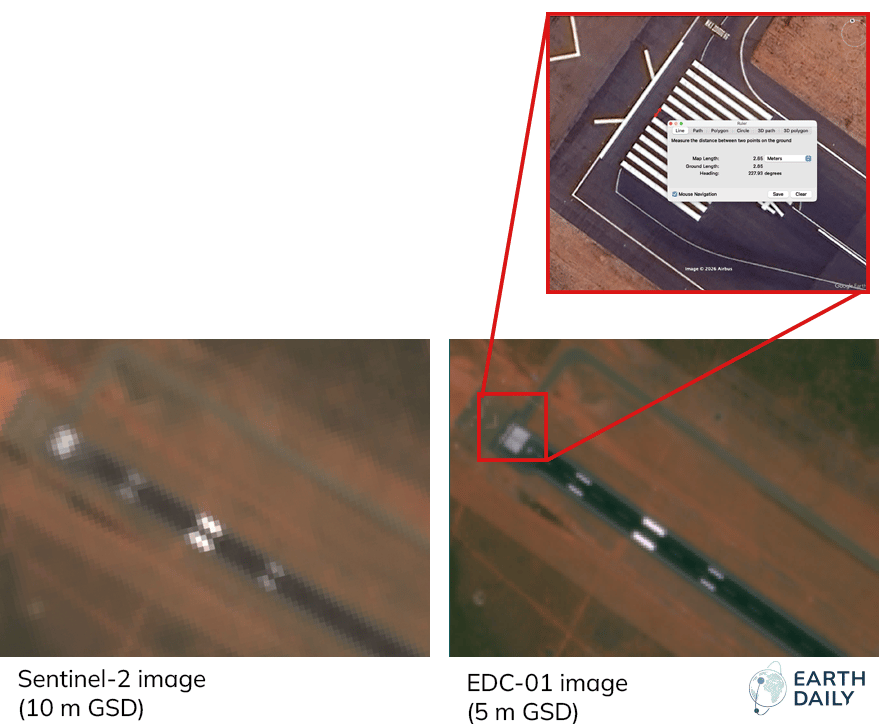
For many commercial space companies, the ground sampling distance and the spatial resolution are quite different, which leads to confusing results. Left: Sentinel-2 is a true 10m system;Right: EarthDaily is a true 5m system (unsharpened). Can clearly see separation of feature that is 2.6m apart in the high-resolution image from Google Earth (zoom image)
For many commercial systems, ground sampling distance and true spatial resolution are not the same thing. A nominal five-meter system does not always deliver five-meter performance. Our system meets specification as a true five-meter system.
For some visual applications, optional physics-based point spread function (PSF) sharpening can be applied, trading some signal-to-noise ratio for increased apparent sharpness. At native five meters, the data is already optimized for analytical stability and AI applications.
The Ground Segment is Half the Mission
Space hardware gets the headlines. Ground systems determine whether the mission actually works.
Orbit is only half the problem. The other half is transforming raw pixels into stable, analysis-ready measurements at scale. Many commercial space companies focus primarily on the spacecraft, while the ground segment becomes an afterthought.
EarthDaily is not a hardware manufacturer. We partner with industry leaders for spacecraft and payload systems. Our focus has been building the ground segment as a first-class product. Our ground segment innovation includes:
- Automated calibration pipelines
- Atmospheric correction
- Cloud, shadow, and haze masking
- Analysis Ready Data (ARD) compliance
- Quality assurance automation at scale
- Archiving and distribution systems built for enterprise workloads
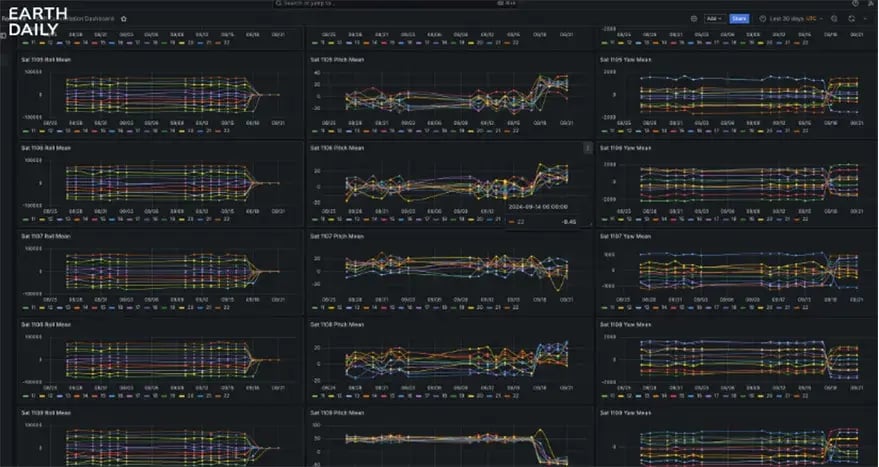
One of the many dashboards monitoring our mission.
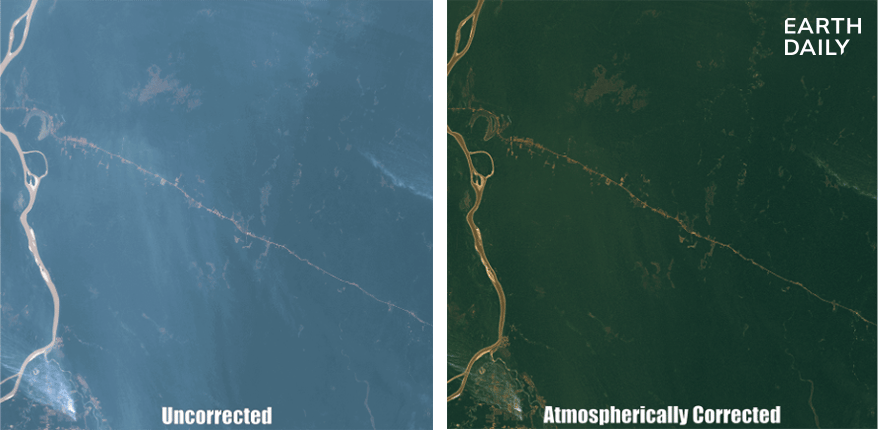
Comparison of uncorrected imagery Sentinel-2 data (left) with advanced atmospherically corrected imagery by EarthDaily (right) reveals more accurate features for improved analysis.
We have already demonstrated this discipline using public satellite data, including Sentinel-2 and Landsat, producing AI-ready mosaics and building processing systems that will carry forward to EarthDaily data. As we build our scientific mission, we stand on the shoulders of those giants — their open data enabled calibration and validation of our processing architecture.
Because our processing system is aligned with major science missions from the start, interoperability and consistency are built in rather than added later.
The goal is not to release static images that look impressive. The goal is to deliver a continuously reliable, stable data infrastructure for change detection and forecasting.
Download the PDF to view early EarthDaily imagery.
More in this series:
About the Author