
.jpg?width=289&height=168&name=Data%20Use%20cases%20(1).jpg)

EarthDaily’s data is built for science-grade measurement at the system level, combining consistent acquisition, calibrated sensors, spectral depth, true 5 m resolution, and continuous cross-calibration to support reliable change detection over time.
In the first blog in this series, we defined what “science-grade” Earth observation data actually means. It is not a marketing label, but a set of conditions: calibrated measurements, validated accuracy, consistency over time, and the ability to compare data across geographies and systems with known uncertainty.
The next question is more practical. If this is what science-grade requires, how do you build a system that can actually deliver it?
Science-grade data isn’t something you fix in processing. Differences in viewing geometry, atmosphere, and sensor behavior show up directly in the data. If they’re not controlled at capture, they carry through and compound over time. This is why science-grade data has to be built at the system level.
The EarthDaily constellation is designed around these principles.
The System at a Glance
EarthDaily’s constellation is designed as a measurement system rather than an imaging system. At a high level, it combines:
- 22 spectral bands across visible, near-infrared, shortwave infrared, and thermal regions
- True 5 m spatial resolution (unsharpened)
- Wide swath (~240 km) for large-area coverage
- Daily, repeatable global acquisition
- Continuous calibration and cross-calibration with established science missions
- Pre-processed, standardized data delivered with low latency
This combination of spectral depth, spatial resolution, and consistent acquisition allows the system to support measurement over time, rather than isolated observations.
Consistency: Controlling How the Earth is Observed
Science-grade data depends on consistency. Measurements change with viewing angle, illumination, and acquisition timing. If those aren’t controlled, the variation carries into the data.
EarthDaily handles this at the point of capture, using stable, repeatable observation conditions:
- Nadir imaging to minimize geometric variation: Observations are made close to nadir, reducing distortion and variation caused by viewing angle.
- Consistent viewing geometry and local solar time for each pass: Sun-synchronous orbits ensure the same lighting conditions and viewing geometry on every revisit.
- Identical sensor configurations across the constellation: Measurements remain consistent across satellites, avoiding variation between platforms.
In practical terms, this means the same location is observed under the same conditions – same angle, same geometry, and consistent time of day – on every revisit. Changes in the data therefore reflect changes on the ground, not differences in observation.
Measurement: Capturing Physical Signals, Not Visual Output
Science-grade systems measure physical properties of the Earth. Pixel values must correspond to quantities such as reflectance or temperature, not just visual brightness. Without that, data remains an observation rather than a usable signal.
EarthDaily’s system is structured around calibrated signals across approximately 22 spectral bands, spanning visible, near-infrared, shortwave infrared, and thermal regions. This allows vegetation condition, moisture, and temperature to be measured consistently over time.
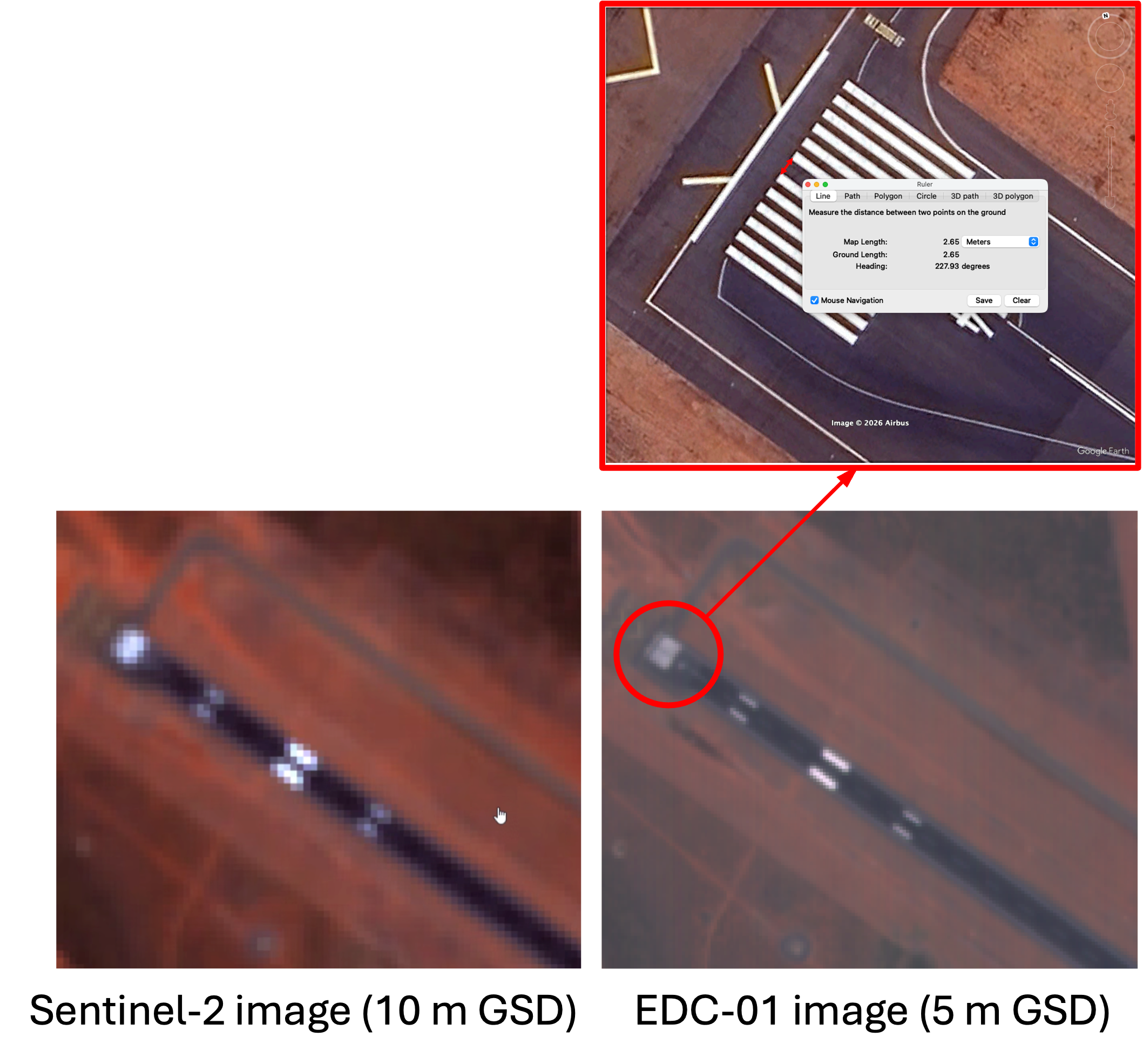 For many commercial space companies, the ground sampling distance and the spatial resolution are quite different, which leads to confusing results. Left: Sentinel-2 is a true 10m system;Right: EarthDaily is a true 5m system (unsharpened). Can clearly see separation of feature that is 2.6m apart in the high-resolution image from Google Earth (zoom image)
Spatial detail is also treated as a measurement problem. The system is designed as a true 5 m measurement, rather than relying on sharpening to enhance apparent resolution. This ensures that the detail present in the data reflects what the sensor actually measures.
Combined with a swath of approximately 240 km, the system maintains consistency across both fine detail and large geographic areas.
Calibration: Keeping Measurements Stable Over Time
Measurements drift over time. Without continuous calibration, that drift carries through the data, especially across sensors and time-series.
EarthDaily treats calibration as an ongoing operational process. Measurement stability is maintained through:
- Radiometric accuracy targets on the order of a few percent
- Geometric accuracy maintained within meters
- High signal-to-noise ratios to preserve measurement quality
- Tight satellite-to-satellite consistency across the constellation
These calibrations are traceable to physical reference standards, maintaining comparability across instruments and over time.
Stability is maintained through continuous calibration and validation across global reference sites. The system is cross-calibrated daily against eight established science missions, including Landsat and GOES, with continuous monitoring and correction of drift. Measurements remain comparable across time and systems.
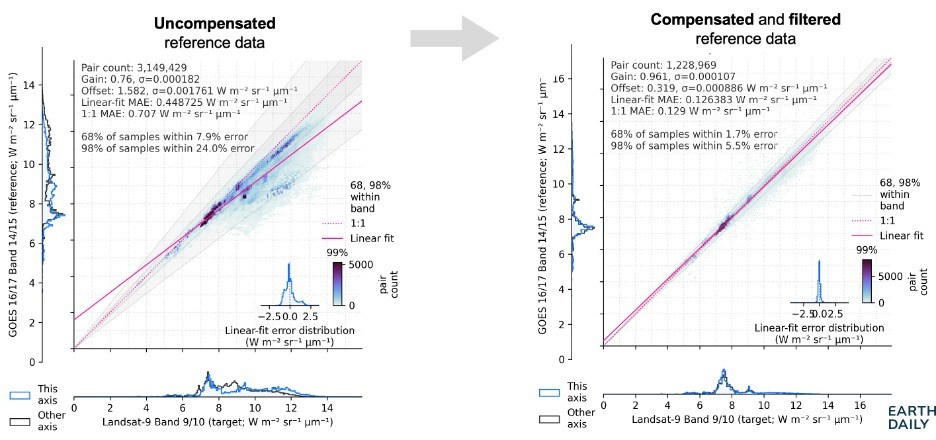 Validating cross calibration between GOES and Landsat-9. Compensating for spectral differences, atmospheric changes, viewing angles is complex and we rigorously model effects so that we can accurately and continuously calibrate our mission.
Spectral Design: Improving Measurement Reliability
Science-grade data depends on correcting for atmospheric and environmental effects. That is not possible without the right spectral information.
The system uses 22 spectral bands across visible, near-infrared, shortwave infrared, and thermal regions. This is not about adding more bands. It is about being able to isolate the signal from the conditions it is captured in.
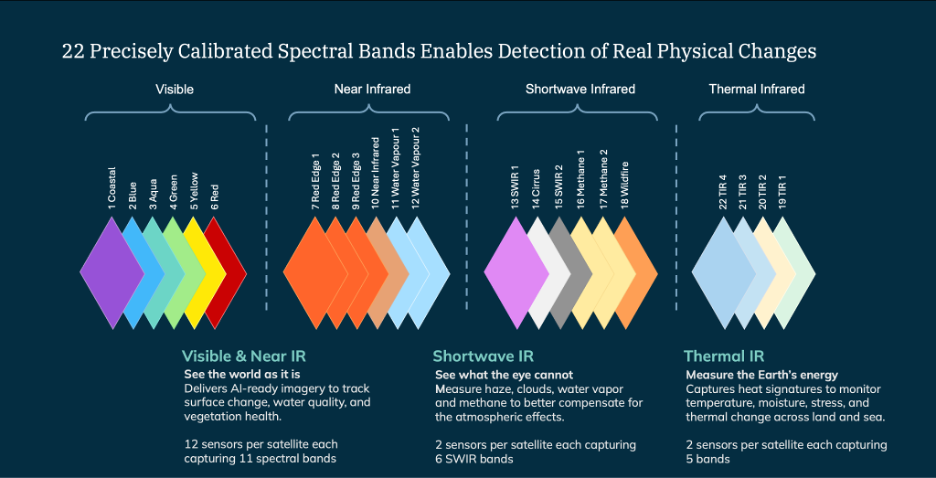
Visible imagery alone is limited. It reflects how the surface appears under specific conditions. Shortwave infrared and thermal bands carry different information -- moisture, material properties, temperature – that is less dependent on those conditions and more directly tied to physical change.
This is important because most of the variation in Earth observation data comes from atmosphere, illumination, and surface complexity. Without sufficient spectral depth, those effects get mixed into the signal.
With the right spectral coverage, they can be separated and corrected. Changes in vegetation condition, surface moisture, and temperature can be measured consistently over time.
Why Consistency Matters More Than Resolution
A single high-resolution image can show detail. It cannot reliably show change. Science-grade data depends on the ability to compare measurements over time. That requires consistency across:
- Days, seasons, and years
- Geographic regions
- Sensors and satellites
If measurements vary due to observation conditions rather than real-world change, analysis breaks down.
Long-running missions like Landsat and Sentinel-2 matter because their measurements hold up over time. Applying that same level of consistency to daily, global coverage is the real challenge.
From Science-Grade Data to Measurement System
In traditional Earth observation, the "heavy lifting" happens after the data is downloaded. Users often spend more time correcting for atmospheric haze, sensor drift, and shifting viewing angles than they do performing actual analysis.
By controlling these variables at the point of capture, the EarthDaily system delivers data that is effectively Analysis Ready. This shifts the focus from data preparation to operational results:
- Reliable Time-Series Analysis: Because the viewing geometry and solar time remain consistent, a change in pixel value represents a real change on the ground rather than a change in the satellite's tilt.
- AI and Machine Learning Stability: AI models are sensitive to "noise." By delivering cross-calibrated, unsharpened data, we provide a stable, high-fidelity input that improves model accuracy and reduces "false positives" in change detection.
- Scalable Global Monitoring: Science-grade consistency allows you to apply the same analytical model to a field in Saskatchewan as you would to a forest in the Amazon, without having to manually normalize the data for different regions.
- Interoperability: Because the system is cross-calibrated with missions like Landsat and Sentinel, EarthDaily data can be seamlessly integrated into existing scientific workflows and historical archives.
This engineering approach ensures that the constellation meets the CEOS Analysis Ready Data (ARD) framework. By adhering to these global standards, the system delivers data that is radiometrically consistent and geometrically aligned, making it immediately usable for large-scale monitoring and AI workflows without the need for additional normalization.
Science-grade Earth observation is defined by the ability to measure change reliably over time.
As Earth observation moves into operational use, the question is simple: does the signal hold up over time? That depends on how the system is built – how observations are made, calibrated, and processed.
And that is what turns Earth observation from imagery into measurement.
About the Author